Tracked shipping to South Africa with premium packaging for just R199 

Ship to
South Africa
0
  • argentina
  • chile
  • colombia
  • españa
  • méxico
  • perú
  • estados unidos
  • internacional

Select your country

Americas

Europe

Rest of the world

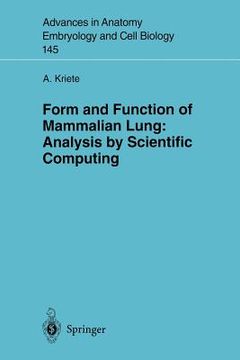
portada form and function of mammalian lung: analysis by scientific computing
Type
Physical Book
Publisher
Year
1998
Language
English
Pages
108
Format
Paperback
Dimensions
23.4 x 15.6 x 0.6 cm
Weight
0.18 kg.
ISBN
3540644946
ISBN13
9783540644941

form and function of mammalian lung: analysis by scientific computing

Andres Kriete (Author) · Springer · Paperback

form and function of mammalian lung: analysis by scientific computing - Kriete, Andres

Cheaper New Book Imported to South Africa *
Delivery: 24 Apr - 21 May Shipping: 11 to 18 business days.
R 1,973.50
Faster New Book Imported to South Africa *
Delivery: 14 Apr - 29 Apr Shipping: 3 to 4 business days.
R 2,315.07
R 1,973.50
Delivery to any South Africa address between Friday, April 24 and Thursday, May 21

Synopsis "form and function of mammalian lung: analysis by scientific computing"

1.1 Overview The precise knowledge of the three-dimensional (3-D) assembly of biological structures is still in its origin. As an example, a widely accepted concept and common belief of the structure of the airway network oflung is that of a regular, dichotomous branching pattern, also known as the trumpet model. This model, first introduced by Weibel in 1963, is often used in clinical and physiological applications. However, if this concept of dichotomy is used to model lung, a shape is obtained that is quite different from a real lung. As a matter of fact, many previous quantitative morphological and stereological investigations of lung did not concentrate on the spatial aspect of lung morphology but delivered data in a more statistical fashion. Accordingly, the functional behavior predicted by such a model becomes questionable and indeed, the morphometrically predicted lung capacity exceeds the physiological required capacity by a factor of 1.3 up to a factor of2. This problem has also been termed a paradox, as discussed by Weibel in 1983. In the rare cases where descriptive models of the mammalian bronchial tree exist, monopodial in small mammals, dichotomous in larger ones, the understanding of the historical and/or functional reasons for size-related changes in the general design is not explainable. This investigation is trying to overcome this gap by computer modeling and functional simulation.

Customers reviews

Frequently Asked Questions about the Book

All books in our catalog are Original.
The book is written in English.
The binding of this edition is Paperback.

Questions and Answers about the Book

Do you have a question about the book? Login to be able to add your own question.

Opinions about Bookdelivery

More customer reviews