Tracked shipping to South Africa with premium packaging for just R199 

Ship to
South Africa
0
  • argentina
  • chile
  • colombia
  • españa
  • méxico
  • perú
  • estados unidos
  • internacional

Select your country

Americas

Europe

Rest of the world

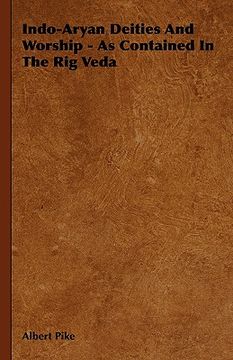
portada indo-aryan deities and worship - as contained in the rig veda
Type
Physical Book
Publisher
Year
2008
Language
English
Pages
668
Format
Hardcover
Dimensions
21.6 x 14.0 x 4.1 cm
Weight
0.99 kg.
ISBN
1443722278
ISBN13
9781443722278
Categories

indo-aryan deities and worship - as contained in the rig veda

Albert Pike (Author) · Fork. Press · Hardcover

indo-aryan deities and worship - as contained in the rig veda - Albert Pike

New Book Imported to South Africa
Delivery: 13 Aug - 21 Aug Shipping: 4 to 5 business days.
R 1,033
R 1,033

Synopsis "indo-aryan deities and worship - as contained in the rig veda"

DEITIES AND WORSHIP by ALBERT PIKE. Originally published in 1872. PREFACE: It. is quite uncertain, now that I have this book finished, whether I shall ever care to publish it. It was not commenced for that purpose and it may always remain a monotype, in manuscript. For it has been written as a study, and not as a teaching for myself and not for others. It is not at all the fruit of a meditated purpose, and was not commenced as a diagnosis of the Deities of the Veda, an attempt to discover the distinctive personality and individuality of each, which it afterwards became, and the fruits of itself to myself have been sufficient to reward me abundantly for the labour it has cost. Nothing has ever so much interested me, as this endeavour to penetrate into the adyta of the ancient Aryan thought, to discover what things, principles or phenomena our remote ancestors worshipped as Gods, what Indra, Varuna, Mitra, Aryaman, the Agvins, Vayu, Vishnu, SavitJfi and the others really were, in the conception of the composers of the Vedic hymns. It has had a singular charm for me, this inquiry into the true mean ing of the epithets and phrases, often, in appearance, indiscriminately applied to different Deities, often seemingly inappropriate, and the expres sions of a wild and riotous imagination into the true meaning of names and epithets and phrases that became, literally accepted and misunderstood, the sources, seeds or germs of the legendary myths and many of the Deities of the Grecian mythology and the Brahmanic fables and pantheon. And I have felt the most intense satisfaction in deciphering, as it seemed to me I did, these hieroglyphs of ancient Aryan thought in bringing myself into relation en rapport with these old Poets and Philosophers, under standing them in part, and thinking with them in deciphering their hiero glyphics, infinitely better worth the labour than all that are engraved on the monuments of Egypt and Assyria, and in solving one by one the enigmas contained in their figurative and seemingly extravagant language, whose meaning was only to be discovered by beginning with their simplest notions and conceptions, and making the curious processes of their thought my own trying as it were, to be them, intellectually, and to think their thoughts. Thus I satisfied myself that every one of their Deities had for them a perfectly distinct and dear personality and individuality that their ideas were not in the least vague, incoherent or confused that their imagination was perfectly - ell-regulated, and that every epithet and phrase was logically appropriate and correct. So also, upon a partial examination, I found it to be in the ancient Zarathustrian G tMs, which are, I do not doubt, even older than the Vedic hymns. I found in both, the most profound philosophic or metaphysical ideas, which those of every philosophy and religion have merely developed and that, so far from being Barbarians or Savages, the old Aryan herdsmen and husbandmen, in the Indus country under the Himalayan Mountains, on the rivers of Bactria, and, long before, on the Scythic Steppes where they originated, were men of singularly clear and acute intellects, profound thought and an infinite reverence of the beings whom they worshipped. The inquiry has opened to me an entirely new chapter of the history of human thought, and given me an infinitely higher conception of the Aryan intellect...
Albert Pike
  (Author)
View Author's Page
Albert Pike (Boston, 1809 – Washington D.C., 1891) was a lawyer, military officer, poet, and prominent leader of American Freemasonry. In 1859, he was elected Sovereign Grand Commander of the Supreme Council of the 33rd Degree of the Ancient and Accepted Scottish Rite for the Southern Jurisdiction of the United States, a position he held until his death. During his tenure, Pike devoted much of his time to the development of the esoteric rituals of the order, establishing himself as a central figure in the history of American Freemasonry.

His most influential work is Morals and Dogma of the Ancient and Accepted Scottish Rite of Freemasonry (1871), an extensive treatise of 861 pages that explores the symbolism and philosophy of the first 32 degrees of the rite. This book became an essential guide for 19th-century Masons and was distributed among the members of the rite in the Southern Jurisdiction of the U.S. until 1974. In addition to his Masonic work, Pike wrote on religious and philosophical subjects, including Indo-Aryan Deities and Worship as Contained in the Rig-Veda, reflecting his interest in ancient spiritual traditions.
See more
See less

Customers reviews

Frequently Asked Questions about the Book

All books in our catalog are Original.
The book is written in English.
The binding of this edition is Hardcover.

Questions and Answers about the Book

Do you have a question about the book? Login to be able to add your own question.

Opinions about Bookdelivery

More customer reviews