Tracked shipping to South Africa with premium packaging for just R199 

Ship to
South Africa
0
  • argentina
  • chile
  • colombia
  • españa
  • méxico
  • perú
  • estados unidos
  • internacional

Select your country

Americas

Europe

Rest of the world

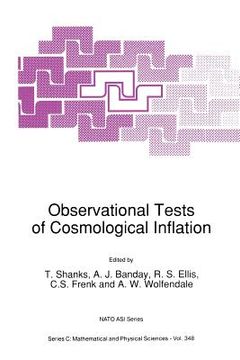
portada Observational Tests of Cosmological Inflation
Type
Physical Book
Publisher
Language
English
Pages
483
Format
Paperback
Dimensions
23.4 x 15.6 x 2.6 cm
Weight
0.70 kg.
ISBN13
9789401055529

Observational Tests of Cosmological Inflation

Shanks, T. ; Banday, A. J. ; Ellis, Richard S. (Author) · Springer · Paperback

Observational Tests of Cosmological Inflation - Shanks, T. ; Banday, A. J. ; Ellis, Richard S.

Cheaper New Book Imported to South Africa
Delivery: 14 Aug - 27 Aug Shipping: 13 to 17 business days.
R 3,404
Faster New Book Imported to South Africa
Delivery: 04 Aug - 12 Aug Shipping: 5 to 6 business days.
R 4,789
R 3,404

Synopsis "Observational Tests of Cosmological Inflation"

This book represents the proceedings from the NATO sponsored Advanced Research Workshop entitled "Observational Tests of Inflation" held at the University of Durham, England on the 10th-14th December, 1990. In recent years, the cosmological inflation model has drawn together the worlds of particle physics, theoretical cosmology and observational astronomy. The aim of the workshop was to bring together experts in all of these fields to discuss the current status of the inflation theory and its observational predictions. The simplest inflation model makes clear predictions which are testable by astronomical observation. Foremost is the prediction that the cosmological density parameter, no, should have a value negligibly different from the critical, Einstein-de Sitter value of 00=1. The other main prediction is that the spectrum of primordial density fluctuations should be Gaussian and take the Harrison-Zeldovich form. The prediction that n =l, in patticular, leads to several important consequences o for cosmology. Firstly, there is the apparent contradiction with the limits on baryon density from Big Bang nucleosynthesis which has led to the common conjecture that weakly interacting particles rather than baryons may form the dominant mass constituent of the Universe. Secondly, with n =l, the age of the Universe is uncomfortably short if o the Hubble constant and the ages of the oldest star clusters lie within their currently believed limits.

Customers reviews

Frequently Asked Questions about the Book

All books in our catalog are Original.
The book is written in English.
The binding of this edition is Paperback.

Questions and Answers about the Book

Do you have a question about the book? Login to be able to add your own question.

Opinions about Bookdelivery

More customer reviews