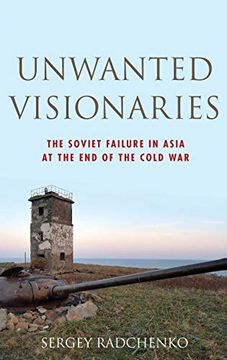
Unwanted Visionaries: The Soviet Failure in Asia at the end of the Cold war (Oxford Studies in International History)
Sergey Radchenko
Synopsis "Unwanted Visionaries: The Soviet Failure in Asia at the end of the Cold war (Oxford Studies in International History) "
The European and American dimensions of Mikhail Gorbachev's foreign policy captured the imagination of contemporary observers and, later, historians. The collapse of socialism in Eastern Europe and the fall of the Berlin Wall were the grand events that marked the European finale of the Cold War. The Cold War ended differently in Asia, where there was no easy closure, no great fanfare, and little credit awarded for changing the world. Yet Gorbachev was fascinated by Asia and in his early years in power, he addressed the subject of Asia's rise and the importance of Soviet engagement with the region. He spent years strategizing his Asian foreign policies and attempting to build Soviet relationships with its regional neighbors, particularly alongside China. In the end, Russia was never accepted by Europe as part of the West, but it also failed in its efforts to become a regional power. With the end of the Cold War, Russia was marginalized in Asia, politically and economically, unable to fit into the changed environment of international affairs while adhering to the basic principles that made it a superpower. In this broad-ranging and deeply researched second book, Sergey Radchenko gracefully narrates and analyzes the end of the Cold War in Asia. Among the relationships he addresses is the Sino-Soviet normalization, which emerged in response to the difficulties both sides had with the United States; the rise and fall of the Soviet-Indian alliance, which Gorbachev envisioned as central to offsetting US alliances in the region; failed Soviet efforts to mend fences with Japan and to tap into Japanese capital to develop Siberia and the Far East; Soviet efforts to influence relations between Vietnam and Cambodia; and the USSR's decision to normalize relations with South Korea after North Korea provided resistant to political reform. Radchenko sheds new light on the actions of Gorbachev, Deng Xiaoping, Margaret Thatcher, Boris Yeltsin, and George H.W. Bush, among others. Based on archival research in Russia, China, Mongolia, India, the United States, Britain, numerous European countries, among other places, and interviews with former policy makers in a dozen countries, Radchenko has crafted a book that will appeal broadly to scholars, students, and general readers. Cold War historians; historians of Japan, Korea, China, and India; international relations scholars and political scientists will comprise the academic market.