Tracked shipping to South Africa with premium packaging for just R199 

Ship to
South Africa
0
  • argentina
  • chile
  • colombia
  • españa
  • méxico
  • perú
  • estados unidos
  • internacional

Select your country

Americas

Europe

Rest of the world

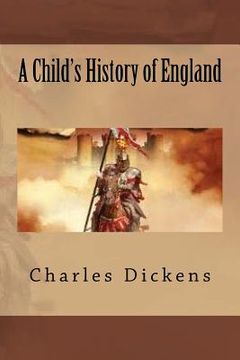
portada A Child's History of England
Type
Physical Book
Publisher
Language
English
Pages
500
Format
Paperback
Dimensions
22.9 x 15.2 x 2.6 cm
Weight
0.66 kg.
ISBN13
9781540622075

A Child's History of England

Charles Dickens (Author) · Createspace · Paperback

A Child's History of England - Charles Dickens

New Book Imported to South Africa
Delivery: 28 Aug - 11 Sep Shipping: 16 to 20 business days.
R 739
R 739

Synopsis "A Child's History of England"

Extract: CHAPTER I-ANCIENT ENGLAND AND THE ROMANS If you look at a Map of the World, you will see, in the left-hand upper corner of the Eastern Hemisphere, two Islands lying in the sea. They are England and Scotland, and Ireland. England and Scotland form the greater part of these Islands. Ireland is the next in size. The little neighbouring islands, which are so small upon the Map as to be mere dots, are chiefly little bits of Scotland, -broken off, I dare say, in the course of a great length of time, by the power of the restless water. In the old days, a long, long while ago, before Our Saviour was born on earth and lay asleep in a manger, these Islands were in the same place, and the stormy sea roared round them, just as it roars now. But the sea was not alive, then, with great ships and brave sailors, sailing to and from all parts of the world. It was very lonely. The Islands lay solitary, in the great expanse of water. The foaming waves dashed against their cliffs, and the bleak winds blew over their forests; but the winds and waves brought no adventurers to land upon the Islands, and the savage Islanders knew nothing of the rest of the world, and the rest of the world knew nothing of them. It is supposed that the Phoenicians, who were an ancient people, famous for carrying on trade, came in ships to these Islands, and found that they produced tin and lead; both very useful things, as you know, and both produced to this very hour upon the sea-coast. The most celebrated tin mines in Cornwall are, still, close to the sea. One of them, which I have seen, is so close to it that it is hollowed out underneath the ocean; and the miners say, that in stormy weather, when they are at work down in that deep place, they can hear the noise of the waves thundering above their heads. So, the Phoenicians, coasting about the Islands, would come, without much difficulty, to where the tin and lead were.
Charles Dickens
  (Author)
View Author's Page
Charles Dickens (February 7, 1812 - June 9, 1870) was born in Portsmouth and was the eldest son of a Royal Navy clerk. At twelve, his father's imprisonment for debt forced him to work in a blacking factory. His education was sporadic: he taught himself shorthand, worked as a clerk in a law office, and eventually became a parliamentary correspondent for the Morning Chronicle.

Coming from a humble family, "good old Charles" did not receive formal education until he was nine, and was heavily criticized by the critics of the time for being too self-taught. His life took an unexpected turn with his father's imprisonment for debts, moving his family to live with him in jail, allowed at that time by British laws. At the age of 12, he was already considered fit to start working in a dye factory. Although his family's situation had improved, his mother insisted he keep working there, inspiring him to write one of his masterpieces, David Copperfield.

His articles, later collected in Scenes from London Life by "Boz" (1836-1837), were very successful, and with the appearance in 1837 of The Posthumous Papers of the Pickwick Club, Dickens became a true publishing phenomenon. Novels such as Oliver Twist (1837-1839), Nicholas Nickleby (1838-1839), and Barnaby Rudge (1841) gained enormous popularity, as did some travel chronicles, such as Pictures from Italy (1846). With Dombey and Son (1846-1848) he began his mature period, of which good examples are David Copperfield (1849-1850), his first novel in the first person and his favorite, in which he developed some autobiographical episodes; Bleak House (1852-1853); Little Dorrit (1855-1857), A Tale of Two Cities (1859), Great Expectations (1860-1861), and Our Mutual Friend (1864-1865). He died at Gad's Hill, his country house in Higham, in the county of Kent.
See more
See less

Customers reviews

Frequently Asked Questions about the Book

All books in our catalog are Original.
The book is written in English.
The binding of this edition is Paperback.

Questions and Answers about the Book

Do you have a question about the book? Login to be able to add your own question.

Opinions about Bookdelivery

More customer reviews