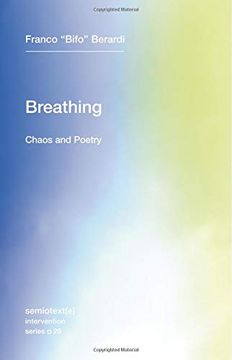
Synopsis "Breathing: Chaos and Poetry (Semiotext(E) "
The increasingly chaotic rhythm of our respiration, and the sense of suffocation that grows everywhere: an essay on poetical therapy.Since the hopeful days of the Occupy movement, many things have changed in the respiration of the world, and we have entered a cycle of spasm, despair, and chaos. Breathing is a book about the increasingly chaotic rhythm of our respiration, about the sense of suffocation that grows everywhere."I can't breathe." These words panted by Eric Garner before dying, strangled by a police officer on the streets of Staten Island, capture perfectly catching the overall sentiment of our time. In Breathing, Franco Bifo Berardi comes back to the subject that was the core of his 2011 book, The Uprising the place of poetry in the relations between language, capital, and possibility. In The Uprising, he focuses on poetry as an anticipation of the trend toward abstraction that led to the present form of financial capitalism. In Breathing, he tries to envision poetry as the excess of the field of signification, as the premonition of a possible harmony inscribed in the present chaos. The Uprising was a genealogical diagnosis. Breathing is an essay on poetical therapy. How we deal with chaos, as we know that those who fight against chaos will be defeated, because chaos feeds upon war? How do we deal with suffocation? Is there a way out from the corpse of financial capitalism?
Franco “Bifo” Berardi (nacido en Bolonia en 1949) es un filósofo, escritor y agitador cultural italiano muy influyente dentro del movimiento autonomista. Se formó en estética en la Universidad de Bolonia y participó activamente en el movimiento estudiantil de 1968. Durante los años 70, fue fundador de la revista A/Traverso y cofundador de Radio Alice, la primera emisora pirata de Italia, clave en el activismo mediático de la época. También fue parte del grupo Potere Operaio y vivió en París tras ser perseguido durante la represión estatal, donde encontró influencias intelectuales de Félix Guattari. Más adelante, pasó tiempo en ciudades como Nueva York y San Francisco.
Hoy enseña historia social de la comunicación en la Academia de Bellas Artes de Brera, en Milán, y ha sido pionero en movimientos como TV Orfeo, la primera televisión comunitaria italiana. Como ensayista, ha publicado decenas de libros en diversos idiomas, abordando temas como el trabajo, la comunicación, la alienación, la psicopolítica y los efectos del capitalismo posindustrial.
Es autor de obras destacadas como La fábrica de la infelicidad, Generación post-alfa, Fenomenología del fin, La sublevación, El umbral y La segunda venida, entre muchas otras. Su pensamiento combina crítica cultural, análisis del trabajo y propuestas poéticas y subjetivas para enfrentar el semiocapitalismo moderno.