Tracked shipping to South Africa with premium packaging for just R199 

Ship to
South Africa
0
  • argentina
  • chile
  • colombia
  • españa
  • méxico
  • perú
  • estados unidos
  • internacional

Select your country

Americas

Europe

Rest of the world

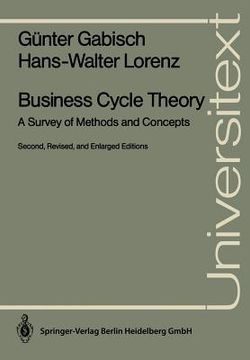
portada business cycle theory: a survey of methods and concepts
Type
Physical Book
Publisher
Year
1989
Language
English
Pages
250
Format
Paperback
Dimensions
24.4x17x1.4 cm
Weight
0.43 kg.
ISBN
3540510591
ISBN13
9783540510598
Edition No.
0002

business cycle theory: a survey of methods and concepts

Hans-Walter Lorenz (Author) · Günter Gabisch (Author) · Springer · Paperback

business cycle theory: a survey of methods and concepts - Gabisch, Günter ; Lorenz, Hans-Walter

Cheaper New Book Imported to South Africa
Delivery: 07 Dec - 16 Dec Shipping: 14 to 18 business days.
R 992
Faster New Book Imported to South Africa
Delivery: 24 Nov - 30 Nov Shipping: 5 to 6 business days.
R 1,263
R 992

Synopsis "business cycle theory: a survey of methods and concepts"

"Is the business cycle obsolete?" This often cited title of a book edited by Bronfenbren- ner with the implicit affirmation of the question reflected the attitude of mainstream macroeconomics in the 1960s regarding the empirical relevance of cyclic motions of an economy. The successful income policies, theoretically grounded in Keynesian macroec- onomics, seemed to have eased or even abolished the fluctuations in Western economies which motivated studies of many classical and neoclassical economists for more than 100 years. The reasoning behind the conviction that business cycles would increasingly be- come irrelevant was rather simple: if an economy fluctuates for whatever reason, then it is almost always possible to neutralize these cyclic motions by means of anticyclic demand policies. From the 1950s until the mid-1960s business cycle theory had often been consid- ered either as an appendix to growth theory or as an academic exercise in dynamical economics. The common business cycle models were essentially multiplier-accelerator models whose dependence on particular parameter values (in order to exhibit oscillatory motion) suggested a rather improbable occurrence of persistent fluctuations. The obvi- ous success in compensating business cycles in those days prevented intensive concern with the occurrence of cycles. Rather, business cycle theory turned into stabilization theory which investigated theoretical possibilities of stabilizing a fluctuating economy. Many macroeconomic textbooks appeared in the 1960s which consequently identified business cycle theory with inquiries on the possibilities to stabilize economies by means of active fiscal or monetary policies.

Customers reviews

Frequently Asked Questions about the Book

All books in our catalog are Original.
The book is written in English.
The binding of this edition is Paperback.

Questions and Answers about the Book

Do you have a question about the book? Login to be able to add your own question.

Opinions about Bookdelivery

More customer reviews