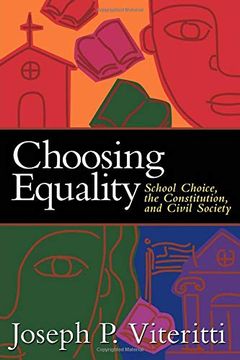
Choosing Equality: School Choice, the Constitution, and Civil Society
Joseph P. Viteritti
Synopsis "Choosing Equality: School Choice, the Constitution, and Civil Society "
America is now in the second generation of debate on school choice. The first was prompted by the provocative voucher proposal conceived by Milton Friedman in 1955 and brought into the mainstream by Chubb and Moe's seminal book Politics, Markets, and American Schools (Brookings, 1990). It introduced a pure market model in which schools would be publicly financed but privately operated. While opponents continue to contend that choice will lead to the demise of public education, the weakening of civil society, and the fostering of separate and unequal systems of education, Joseph P. Viteritti argues that these long-held assertions must give way to present realities. The rich and diverse experience we have had with magnet schools, controlled choice, inter-district choice, charter schools, privately funded vouchers, and public vouchers in Milwaukee and Cleveland provides a solid basis for crafting a choice policy that enhances the educational opportunities of children whose needs are not being met by the present system of public education. Drawing on his background as a political scientist, legal scholar, and education practitioner, Viteritti starts his book with the promise articulated in the landmark Brown decision of 1954. After reviewing a variety of policy initiatives enacted to promote educational opportunity, he finds that the nation has fallen short of providing decent schooling for its most disadvantaged children, and in so doing has delayed the movement toward social and political equality. Viteritti does not contend that choice in the form of charter schools or vouchers for the poor is a solution to racial inequality, but he believes that these forms of choice can move the country in the proper direction. He insists that the nation cannot pretend to have a serious commitment to the goal of educational equality as long as choice is available only to those with the private means to afford it. Acknowledging the serious legal and civic concerns registered by choice opponents, Viteritti turns their arguments on their heads. He proposes that providing poor people with public support to attend religious schools is consistent with the pluralist constitutional model envisioned by Madison and the practices common to contemporary democratic societies. He explains how denying choice to the poor undermines the redistributive social agenda of the modern liberal state, and how a strict standard of church-state separation is out of touch with the culture of poor minority communities where the church is the most viable institution for social progress. Viteritti warns that by failing to appreciate the crucial role that religious congregations play in inner-city neighborhoods, liberal social analysts have compromised the civic vitality of poor communities. He also admonishes conservatives to abandon the pure market approach to education reform in favor of a choice policy designed specifically to benefit the poor. He concludes that choice merits support from all sides of the political spectrum, because a sound education is an essential foundation for any policy strategy designed to promote a healthy democratic society.