Tracked shipping to South Africa with premium packaging for just R199 

Ship to
South Africa
0
  • argentina
  • chile
  • colombia
  • españa
  • méxico
  • perú
  • estados unidos
  • internacional

Select your country

Americas

Europe

Rest of the world

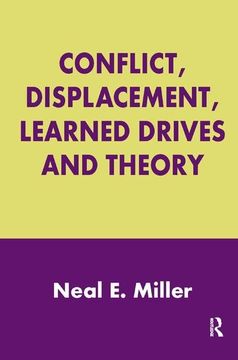
portada Conflict, Displacement, Learned Drives and Theory
Type
Physical Book
Publisher
Language
English
Pages
421
Format
Hardcover
ISBN13
9781138521018
Edition No.
1

Conflict, Displacement, Learned Drives and Theory

Miller, Neal E. (Author) · Routledge · Hardcover

Conflict, Displacement, Learned Drives and Theory - Miller, Neal E.

Cheaper New Book Imported to South Africa
Delivery: 02 Oct - 12 Oct Shipping: 13 to 14 business days.
R 4,190
Faster New Book Imported to South Africa
Delivery: 22 Sep - 30 Sep Shipping: 5 to 6 business days.
R 5,080
R 4,190

Synopsis "Conflict, Displacement, Learned Drives and Theory"

Neal E. Miller's pioneering work in experimental psychology has earned him worldwide respect. This first of a two-volume collection of his work brings together twenty-one of Miller's most important and representative essays on conflict, displacement, learned drives, and theory. They were selected for both their current relevance and their historical significance.The theoretical and experimental analysis of conflict behavior in Part I grew out of an interest in applying the laws of learning that Pavlov discovered in the laboratory to certain phenomena that Freud discovered in the clinic. This led naturally to a similar analysis of displacement in Part II and also to the studies of fear as a learnable drives in Part III.In contrast with the ease of establishing learned fear on the basis of pain, the studies in Part IV show that it is much more difficult, and perhaps impossible, to establish learned appetitive drives on the basis of hunger or thirst. In the first experiments on drugs, Part V attempted to test the applicability of some of the principles discovered by Pavlov in experiments on classical conditioning to the trial-and-error learning situation studied by Thorndike and now frequently called operant conditioning. Later studies of drugs are closely related to the work on fear and conflict and, hence, are grouped nearby.The first of the theoretical chapters in Part VI summarizes the work on conflict behavior as well as many of my other theoretical ideas, including a cybernetic analysis of behavior. Another chapter is the result of an assignment to represent behavioral sciences, from physiology through anthropology.

Customers reviews

Frequently Asked Questions about the Book

All books in our catalog are Original.
The book is written in English.
The binding of this edition is Hardcover.

Questions and Answers about the Book

Do you have a question about the book? Login to be able to add your own question.

Opinions about Bookdelivery

More customer reviews