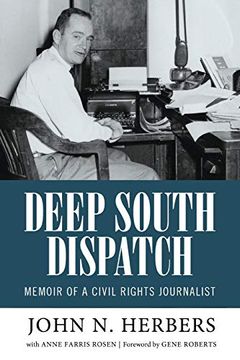
Deep South Dispatch: Memoir of a Civil Rights Journalist (Willie Morris Books in Memoir and Biography) - Herbers, John N. ; Rosen, Anne Farris ; Roberts, Gene
Cheaper New Book
Imported
to South Africa
Delivery: 10 Dec - 21 Dec
Shipping: 16 to 20 business days.
R 509
Faster New Book
Imported
to South Africa
Delivery: 19 Nov - 25 Nov
Shipping: 1 to 2 business days.
R 762
R 509
R 762
Choose the list to add your product or create one New List
Deep South Dispatch: Memoir of a Civil Rights Journalist (Willie Morris Books in Memoir and Biography)
Herbers, John N. ; Rosen, Anne Farris ; Roberts, Gene
Synopsis "Deep South Dispatch: Memoir of a Civil Rights Journalist (Willie Morris Books in Memoir and Biography) "
Former New York Times correspondent John N. Herbers (1923-2017), who covered the civil rights movement for more than a decade, has produced Deep South Dispatch: Memoir of a Civil Rights Journalist, a compelling story of national and historical significance. Born in the South during a time of entrenched racial segregation, Herbers witnessed a succession of landmark civil rights uprisings that rocked the country, the world, and his own conscience. Herbers's retrospective is a timely and critical illumination on America's current racial dilemmas and ongoing quest for justice.Herbers's reporting began in 1951, when he covered the brutal execution of Willie McGee, a black man convicted for the rape of a white housewife, and the 1955 trial for the murder of Emmett Till, a black teenager killed for allegedly whistling at a white woman. With immediacy and first-hand detail, Herbers describes the assassination of John F. Kennedy; the death of four black girls in the Birmingham, Alabama, church bombing; extensive travels and interviews with Martin Luther King Jr.; Ku Klux Klan cross-burning rallies and private meetings; the Freedom Summer murders in Philadelphia, Mississippi; and marches and riots in St. Augustine, Florida, and Selma, Alabama, that led to passage of national civil rights legislation.This account is also a personal journey as Herbers witnessed the movement with the conflicted eyes of a man dedicated to his southern heritage but who also rejected the prescribed laws and mores of a prejudiced society. His story provides a complex understanding of how the southern status quo, in which the white establishment benefited at the expense of African Americans, was transformed by a national outcry for justice.