Tracked shipping to South Africa with premium packaging for just R199 

Ship to
South Africa
0
  • argentina
  • chile
  • colombia
  • españa
  • méxico
  • perú
  • estados unidos
  • internacional

Select your country

Americas

Europe

Rest of the world

portada Distributed Linear Programming Models in a Smart Grid
Type
Physical Book
Publisher
Language
English
Pages
213
Format
Paperback
Dimensions
23.4 x 15.6 x 1.3 cm
Weight
0.34 kg.
ISBN13
9783319849485

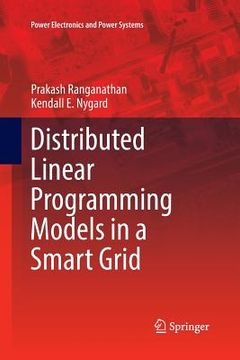
Distributed Linear Programming Models in a Smart Grid

Prakash Ranganathan (Author) · Kendall E. Nygard (Author) · Springer · Paperback

Distributed Linear Programming Models in a Smart Grid - Ranganathan, Prakash ; Nygard, Kendall E.

Cheaper New Book Imported to South Africa
Delivery: 02 Sep - 15 Sep Shipping: 12 to 16 business days.
R 2,270
Faster New Book Imported to South Africa
Delivery: 20 Aug - 28 Aug Shipping: 4 to 5 business days.
R 2,996
R 2,270

Synopsis "Distributed Linear Programming Models in a Smart Grid"

This book showcases the strengths of Linear Programming models for Cyber Physical Systems (CPS), such as the Smart Grids. Cyber-Physical Systems (CPS) consist of computational components interconnected by computer networks that monitor and control switched physical entities interconnected by physical infrastructures. A fundamental challenge in the design and analysis of CPS is the lack of understanding in formulating constraints for complex networks. We address this challenge by employing collection of Linear programming solvers that models the constraints of sub-systems and micro grids in a distributed fashion.The book can be treated as a useful resource to adaptively schedule resource transfers between nodes in a smart power grid. In addition, the feasibility conditions and constraints outlined in the book will enable in reaching optimal values that can help maintain the stability of both the computer network and the physical systems. It details the collection of optimization methods that are reliable for electric-utilities to use for resource scheduling, and optimizing their existing systems or sub-systems. The authors answer to key questions on ways to optimally allocate resources during outages, and contingency cases (e.g., line failures, and/or circuit breaker failures), how to design de-centralized methods for carrying out tasks using decomposition models; and how to quantify un-certainty and make decisions in the event of grid failures.

Customers reviews

Frequently Asked Questions about the Book

All books in our catalog are Original.
The book is written in English.
The binding of this edition is Paperback.

Questions and Answers about the Book

Do you have a question about the book? Login to be able to add your own question.

Opinions about Bookdelivery

More customer reviews