Tracked shipping to South Africa with premium packaging for just R199 

Ship to
South Africa
0
  • argentina
  • chile
  • colombia
  • españa
  • méxico
  • perú
  • estados unidos
  • internacional

Select your country

Americas

Europe

Rest of the world

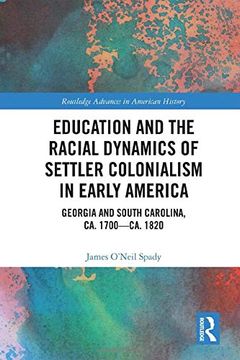
portada Education and the Racial Dynamics of Settler Colonialism in Early America: Georgia and South Carolina, ca. 1700–Ca. 1820: 16 (Routledge Advances in American History)
Type
Physical Book
Publisher
Year
2020
Language
English
Pages
272
Format
Hardcover
ISBN13
9780367437169
Edition No.
1

Education and the Racial Dynamics of Settler Colonialism in Early America: Georgia and South Carolina, ca. 1700–Ca. 1820: 16 (Routledge Advances in American History)

James O&Rsquo;Neil Spady (Author) · Routledge · Hardcover

Education and the Racial Dynamics of Settler Colonialism in Early America: Georgia and South Carolina, ca. 1700–Ca. 1820: 16 (Routledge Advances in American History) - James O&Rsquo;Neil Spady

Cheaper New Book Imported to South Africa
Delivery: 17 Aug - 26 Aug Shipping: 12 to 14 business days.
R 4,273
Faster New Book Imported to South Africa
Delivery: 05 Aug - 13 Aug Shipping: 4 to 5 business days.
R 4,677
R 4,273

Synopsis "Education and the Racial Dynamics of Settler Colonialism in Early America: Georgia and South Carolina, ca. 1700–Ca. 1820: 16 (Routledge Advances in American History) "

This is the first historical monograph to demonstrate settler colonialism’s significance for Early America. Based on a nuanced reading of the archive and using a comparative approach, the book treats settler colonialism as a process rather than a coherent ideology. Spady shows that learning was a central site of colonial struggle in the South, in which Native Americans, Africans, and European settlers acquired and exploited each other’s knowledge and practices. Learned skills, attitudes, and ideas shaped the economy and culture of the region and produced challenges to colonial authority. Factions of enslaved people and of Native American communities devised new survival and resistance strategies. Their successful learning challenged settler projects and desires, and white settlers gradually responded. Three developments arose as a pattern of racialization: settlers tried to prohibit literacy for the enslaved, remove indigenous communities, and initiate some of North America's earliest schools for poorer whites. Fully instituted by the end of the 1820s, settler colonization’s racialization of learning in the South endured beyond the Civil War and Reconstruction.

Customers reviews

Frequently Asked Questions about the Book

All books in our catalog are Original.
The book is written in English.
The binding of this edition is Hardcover.

Questions and Answers about the Book

Do you have a question about the book? Login to be able to add your own question.

Opinions about Bookdelivery

More customer reviews