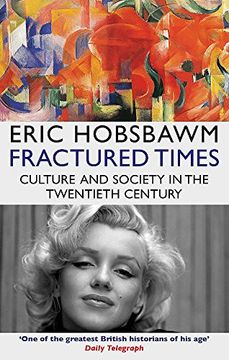
Fractured Times: Culture and Society in the Twentieth Century
Eric Hobsbawm
Synopsis "Fractured Times: Culture and Society in the Twentieth Century "
Born almost a hundred years ago in Vienna - the cultural heart of a bourgeois Mitteleurope - Eric Hobsbawm, who was to become one of the most brilliant and original historians of our age, was uniquely placed to observe an era of titanic social and artistic change. As the century progressed, the forces of Communism and Dadaism, Ibiza and cyberspace, would do battle with the bourgeois high culture fin-de-siècle Vienna represented - the opera, the Burgtheater, the museums of art and science, City Hall. In Fractured Times Hobsbawm unpicks a century of cultural fragmentation and dissolution with characteristic verve and vigour.Hobsbawm examines the conditions that created the great cultural flowering of the belle époque and held the seeds of its disintegration, from paternalistic capitalism to globalisation and the arrival of a mass consumer society. Passionate but never sentimental, Hobsbawm ranges freely across his subject: he records the passing of the golden age of the 'free intellectual' and examines the lives of great, forgotten men; he analyses the relation between art and totalitarianism and dissects cultural phenomena as diverse as surrealism, women's emancipation and the American cowboy myth. Written with consummate imagination and skill, Fractured Times is the last book from one of our greatest modern-day thinkers.
Eric Hobsbawm (Eric John Ernest Hobsbawm; Alejandría, 9 de junio de 1917 – Londres, 1 de octubre de 2012) fue un historiador británico considerado uno de los más influyentes del siglo XX, especialmente por su enfoque marxista y social sobre la historia moderna y contemporánea. Nacido en Egipto en una familia judía, pasó su infancia en Viena y Berlín antes de trasladarse con su familia a Londres en 1933, huyendo del nazismo. Estudió Historia en el King’s College de la Universidad de Cambridge y se doctoró con una tesis sobre la Fabian Society.
Desde 1947, Hobsbawm fue profesor en el Birkbeck College de la Universidad de Londres, donde enseñó Historia social y económica, llegando a ser presidente de la institución en sus últimos años. También fue profesor visitante en universidades de Estados Unidos y Europa. Su obra supera los veinte libros, entre los cuales destacan las series que analizan la transformación de Europa y el mundo moderno: The Age of Revolution, The Age of Capital, The Age of Empire y The Age of Extremes. Estos trabajos abarcan desde la Revolución Francesa hasta el final del llamado «siglo XX corto» (1914-1991), combinando rigor histórico con un compromiso por explicar el funcionamiento de las estructuras sociales y económicas.
Hobsbawm mantuvo una adhesión de largo plazo al marxismo, lo que marcó su interpretación de los acontecimientos históricos y su interés por las luchas de clase, innovando en la historia social y cultural. Su legado es amplio y sigue siendo objeto de estudio y debate académico en todo el mundo.