Tracked shipping to South Africa with premium packaging for just R199 

Ship to
South Africa
0
  • argentina
  • chile
  • colombia
  • españa
  • méxico
  • perú
  • estados unidos
  • internacional

Select your country

Americas

Europe

Rest of the world

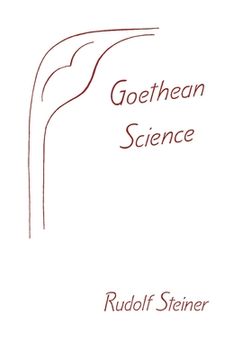
portada Goethean Science: (Cw 1)
Type
Physical Book
Translated by
Language
English
Pages
264
Format
Paperback
Dimensions
21.6x14x1.5 cm
Weight
0.34 kg.
ISBN13
9781957569321

Goethean Science: (Cw 1)

Rudolf Steiner (Author) · William Lindeman (Translated by) · Mercury Press (Canada) · Paperback

Goethean Science: (Cw 1) - Steiner, Rudolf ; Lindeman, William

New Book Imported to South Africa
Delivery: 05 Oct - 13 Oct Shipping: 5 to 6 business days.
R 526
R 526

Synopsis "Goethean Science: (Cw 1)"

Written in 1883 (CW 1) Goethean Science features Rudolf Steiner's introductions to Goethe's works, re-visioning the meaning of knowledge and how we attain it. Goethe had discovered how thinking could be applied to organic nature and that this experience requires not just rational concepts but a whole new way of perceiving.At the youthful age of twenty-one, Steiner was chosen to edit Goethe's scientific writings for the principle Goethe edition of his time. Goethe's literary genius was universally acknowledged; it was Steiner's task to understand and comment on Goethe's scientific achievements. Steiner recognized the significance of Goethe's work with nature and his epistemology, and here began Steiner's own training in epistemology and spiritual science. In an age when science and technology have been linked to great catastrophes, many are looking for new ways to interact with nature. With a fundamental declaration of the interpenetration of our consciousness and the world around us, Steiner shows how Goethe's approach points the way to a more compassionate and intimate involvement with nature.
Rudolf Steiner
  (Author)
View Author's Page
Rudolf Steiner (Donji Kraljevec, Austro-Hungarian Empire, now Croatia, February 25 or 27, 1861-Dornach, Switzerland, March 30, 1925) was an Austrian philosopher, literary scholar, educator, artist, playwright, social thinker, and occultist. He was the founder of anthroposophy, Waldorf education, biodynamic agriculture, anthroposophic medicine, and the new artistic form of eurythmy.

He described anthroposophy as follows: Anthroposophy is a path of knowledge that would like to lead the spiritual in man to the spiritual in the universe. Those who feel certain questions about the essence of man and the world as a vital necessity as the one felt when we are hungry and thirsty can be anthroposophists.

Steiner proposed a form of ethical individualism, to which he later added a more explicitly spiritual component. He derived his epistemology from the worldview of Johann Wolfgang Goethe, according to which thought is an organ of perception just like the eye or the ear. Just as the eye perceives colors and the ear sounds, so thought perceives ideas.
See more
See less

Customers reviews

Frequently Asked Questions about the Book

All books in our catalog are Original.
The book is written in English.
The binding of this edition is Paperback.

Questions and Answers about the Book

Do you have a question about the book? Login to be able to add your own question.

Opinions about Bookdelivery

More customer reviews