Tracked shipping to South Africa with premium packaging for just R199 

Ship to
South Africa
0
  • argentina
  • chile
  • colombia
  • españa
  • méxico
  • perú
  • estados unidos
  • internacional

Select your country

Americas

Europe

Rest of the world

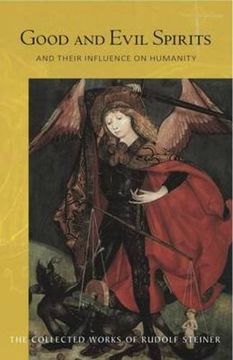
portada Good and Evil Spirits: And Their Influence on Humanity (Cw 102)
Type
Physical Book
Translated by
Introduction by
Language
English
Pages
248
Format
Paperback
Dimensions
23.4x15.7x1.8 cm
Weight
0.39 kg.
ISBN13
9781855843974

Good and Evil Spirits: And Their Influence on Humanity (Cw 102)

Rudolf Steiner (Author) · Anna R. Meuss (Translated by) · Margaret Jonas (Introduction by) · Rudolf Steiner Press · Paperback

Good and Evil Spirits: And Their Influence on Humanity (Cw 102) - Steiner, Rudolf ; Jonas, Margaret ; Meuss, Anna R.

New Book Imported to South Africa
Delivery: 29 Sep - 07 Oct Shipping: 1 to 2 business days.
R 430
R 430

Synopsis "Good and Evil Spirits: And Their Influence on Humanity (Cw 102)"

13 lectures, Berlin, January 6 - June 11, 1908 (CW 102)"We learn gradually to raise our eyes not only to material existence; instead we discover spiritual entities and their actions wherever we look in the universe.... We get to know the deeds of these spirits. We are alive and active and we are within the spiritual entities and their activities." -- Rudolf SteinerThis classic series of lectures presents systematic knowledge on many different spiritual entities, ranging from the higher hierarchies of angels down to hindering demons. Basing his presentation on spiritual-scientific research, Rudolf Steiner intends to awaken us to the existence of these beings and how they interact with all aspects of our lives.Steiner describes how animals, plants, and minerals have group souls--with even an inert stone having a spiritual counterpart in the invisible world. The various planets in the cosmos are connected to great spiritual beings and hierarchies too, as is the zodiac, which is not a static band of fixed stars but is also evolving. Steiner gives a remarkable picture of how Christ relates to the zodiacal constellations and to our own higher aspects. Spiritual entities are associated with the evolution of Earth and the previous stages of its existence--and here Steiner elaborates relevant chapters of his book An Outline of Esoteric Science, explaining how our task on earth is ultimately to develop love rather than wisdom (which was the goal of earth's previous stage).From cosmic considerations, Steiner leads to the spirits of the kingdoms of nature--the elemental beings, with their four classes connecting to the four elements--gnomes, undines, sylphs, and salamanders, or earth, water, air and fire spirits. He describes how elemental beings are created by human activities--with coercion of the views of others leading to "demons," lying leading to "phantoms," and bad social systems to "specters." Spirits are also created in the association of humans and animals, while other spiritual entities connect us with the arts. Steiner emphasizes the importance of developing and appreciating the arts--such as music, sculpture, architecture, painting, and poetry--for the sake of humanity's future evolution.This volume is a translation from German of Das Hereinwirken geistiger Wesenheiten in den Menschen (GA 102)
Rudolf Steiner
  (Author)
View Author's Page
Rudolf Steiner (Donji Kraljevec, Austro-Hungarian Empire, now Croatia, February 25 or 27, 1861-Dornach, Switzerland, March 30, 1925) was an Austrian philosopher, literary scholar, educator, artist, playwright, social thinker, and occultist. He was the founder of anthroposophy, Waldorf education, biodynamic agriculture, anthroposophic medicine, and the new artistic form of eurythmy.

He described anthroposophy as follows: Anthroposophy is a path of knowledge that would like to lead the spiritual in man to the spiritual in the universe. Those who feel certain questions about the essence of man and the world as a vital necessity as the one felt when we are hungry and thirsty can be anthroposophists.

Steiner proposed a form of ethical individualism, to which he later added a more explicitly spiritual component. He derived his epistemology from the worldview of Johann Wolfgang Goethe, according to which thought is an organ of perception just like the eye or the ear. Just as the eye perceives colors and the ear sounds, so thought perceives ideas.
See more
See less

Customers reviews

Frequently Asked Questions about the Book

All books in our catalog are Original.
The book is written in English.
The binding of this edition is Paperback.

Questions and Answers about the Book

Do you have a question about the book? Login to be able to add your own question.

Opinions about Bookdelivery

More customer reviews