Tracked shipping to South Africa with premium packaging for just R199 

Ship to
South Africa
0
  • argentina
  • chile
  • colombia
  • españa
  • méxico
  • perú
  • estados unidos
  • internacional

Select your country

Americas

Europe

Rest of the world

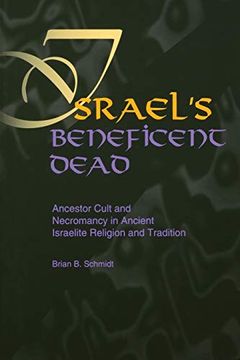
portada Israel's Beneficent Dead: Ancestor Cult and Necromancy in Ancient Israelite Religion and Tradition
Type
Physical Book
Publisher
Language
English
Pages
416
Format
Paperback
ISBN13
9781575060088
Edition No.
1

Israel's Beneficent Dead: Ancestor Cult and Necromancy in Ancient Israelite Religion and Tradition

Brian B. Schmidt (Author) · Eisenbrauns · Paperback

Israel's Beneficent Dead: Ancestor Cult and Necromancy in Ancient Israelite Religion and Tradition - Brian B. Schmidt

New Book Imported to South Africa
Delivery: 14 Jul - 06 Aug Shipping: 5 to 6 business days.
R 1,293
R 1,293

Synopsis "Israel's Beneficent Dead: Ancestor Cult and Necromancy in Ancient Israelite Religion and Tradition "

Did the ancient Israelites perform rituals expressive of the belief in the supernaturalbeneficent power of the dead? Contrary to long held notions of primitive society and the euhemeristic origin of the divine, various factors indicate that the ancestor cult, that is, ancestor veneration or worship, was not observed in the Iron Age Levant. The Israelites did not adopt an ancient Canaanite ancestor cult that became the object of biblical scorn. Yet, a variety of mortuary rituals and cults were performed in Levantine society; mourning and funerary rites and longer-term rituals such as the care for the dead and commemoration. Rituals and monuments in or at burial sites, and especially the recitation of the deceased's name, recounted the dead's lived lives for familial survivors. They served broader social functions as well; e.g., to legitimate primogeniture and to reinforce a community's social collectivity. Another ritual complex from the domain of divination, namely necromancy, might have expressed the Israelite dead's beneficent powers. Yet, was this power to reveal knowledge that of the dead or was it a power conveyed through the dead, but that remained attributable to another supranatural being of non-human origin? Contemporary Assyrian necromancers utilized the ghost as a conduit through which divine knowledge was revealed to ascertain the future and so Judah's king Manasseh, a loyal Assyrian vassal, emulated these new Assyrian imperial forms of prognostication. As a de-legitimating rhetorical strategy, necromancy was then integrated into biblical traditions about the more distant past and attributed fictive Canaanite origins (Deut 18). In its final literary setting, necromancy was depicted as the Achille's heel of the nation's first royal dynasty, that of the Saulides (1 Sam 28), and more tellingly, its second, that of the Davidides (2 Kgs 21:6; 23:24).

Customers reviews

Frequently Asked Questions about the Book

All books in our catalog are Original.
The book is written in English.
The binding of this edition is Paperback.

Questions and Answers about the Book

Do you have a question about the book? Login to be able to add your own question.

Opinions about Bookdelivery

More customer reviews