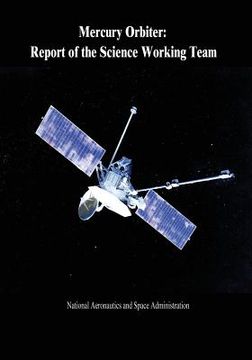
Mercury Orbiter: Report of the Science Working Team
Administration, National Aeronautics and
Synopsis "Mercury Orbiter: Report of the Science Working Team"
The Mariner-10 flybys of Mercury in 1974 and 1975 resulted in the discovery of a planetary magnetic field and an active magnetosphere similar to that of Earth. Based upon the small size of the planet, Mercury's interior was expected to have cooled and solidified long ago. The presence of an intrinsic magnetic field, however, implied an internal dynamo in a fluid core, posing fundamental, unresolved issues concerning the origin, composition, and thermal history of Mercury. The Mariner-10 spacecraft also detected intense particle bursts and magnetic field disturbances, indicating that magnetospheric substorms occur at Mercury. The Mariner-10 images revealed a number of surface features unique to Mercury, including large-scale thrust faults apparently associated with crustal compression as the planet cooled and contracted. Follow-on missions to Mercury were studied in the late 1970's, but deferred because of perceived difficulties in spacecraft propulsion and thermal engineering requirements as they were understood at the time. Within the past few years, it has become apparent that a moderate-cost mission to Mercury can provide the particles and fields measurements and planetological observations necessary to yield major advances in our understanding of Mercury and its magnetosphere. Mercury Orbiter (MeO) as described in this report is such a mission. It involves dual, spin stabilized spacecraft launched by a single Titan-IV Centaur vehicle, a 4-5 year gravity-assist trajectory, and a nominal one Earth-year-duration mission at Mercury. This report presents the results of the Mercury Orbiter Science Working Team (MeO SWT) which held three workshops in 1988/1989 under the auspices of the Space Physics and Planetary Exploration Divisions of NASA Headquarters. Spacecraft engineering and mission design studies at the Jet Propulsion Laboratory were conducted in parallel with this effort and are detailed elsewhere. The findings of the engineering study, summarized in this report, indicate that spin-stabilized spacecraft carrying comprehensive particles and fields experiments and key planetology instruments in highly elliptical orbits can survive and function in Mercury orbit without costly sun-shields and active cooling systems.