Tracked shipping to South Africa with premium packaging for just R199 

Ship to
South Africa
0
  • argentina
  • chile
  • colombia
  • españa
  • méxico
  • perú
  • estados unidos
  • internacional

Select your country

Americas

Europe

Rest of the world

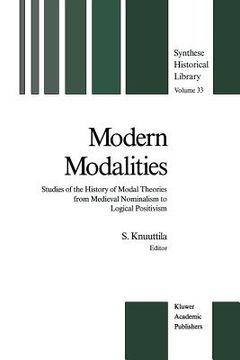
portada Modern Modalities: Studies of the History of Modal Theories from Medieval Nominalism to Logical Positivism
Type
Physical Book
Publisher
Language
English
Pages
346
Format
Paperback
Dimensions
23.4 x 15.6 x 1.9 cm
Weight
0.51 kg.
ISBN13
9789401078122

Modern Modalities: Studies of the History of Modal Theories from Medieval Nominalism to Logical Positivism

Knuuttila, Simo (Author) · Springer · Paperback

Modern Modalities: Studies of the History of Modal Theories from Medieval Nominalism to Logical Positivism - Knuuttila, Simo

Cheaper New Book Imported to South Africa
Delivery: 02 Sep - 15 Sep Shipping: 12 to 16 business days.
R 4,660
Faster New Book Imported to South Africa
Delivery: 20 Aug - 28 Aug Shipping: 4 to 5 business days.
R 5,919
R 4,660

Synopsis "Modern Modalities: Studies of the History of Modal Theories from Medieval Nominalism to Logical Positivism"

The word "modem" in the title of this book refers primarily to post-medieval discussions, but it also hints at those medieval mo- dal theories which were considered modem in contradistinction to ancient conceptions and which in different ways influenced philosophical discussions during the early modem period. The me- dieval developments are investigated in the opening paper, 'The Foundations of Modality and Conceivability in Descartes and His Predecessors', by Lilli Alanen and Simo Knuuttila. Boethius's works from the early sixth century belonged to the sources from which early medieval thinkers obtained their knowledge of ancient thought. They offered extensive discus- sions of traditional modal conceptions the basic forms of which were: (1) the paradigm of possibility as a potency striving to realize itself; (2) the "statistical" interpretation of modal no- tions where necessity means actuality in all relevant cases or omnitemporal actuality, possibility means actuality in some rel- evant cases or sometimes, and impossibility means omnitemporal non-actuality; and (3) the "logical" definition of possibility as something which, being assumed, results in nothing contradic- tory. Boethius accepted the Aristotelian view according to which total possibilities in the first sense must prove their met- tle through actualization and possibilities in the third sense are assumed to be realized in our actual history. On these presump- tions, all of the above-mentioned ancient paradigms imply the Principle of Plenitude according to which no genuine possibility remains unrealized.

Customers reviews

Frequently Asked Questions about the Book

All books in our catalog are Original.
The book is written in English.
The binding of this edition is Paperback.

Questions and Answers about the Book

Do you have a question about the book? Login to be able to add your own question.

Opinions about Bookdelivery

More customer reviews