Tracked shipping to South Africa with premium packaging for just R199 

Ship to
South Africa
0
  • argentina
  • chile
  • colombia
  • españa
  • méxico
  • perú
  • estados unidos
  • internacional

Select your country

Americas

Europe

Rest of the world

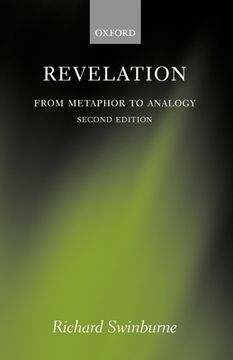
portada Revelation: From Metaphor to Analogy
Type
Physical Book
Year
2007
Language
English
Pages
373
Format
Paperback
Dimensions
20.9x15.4x2.1 cm
Weight
0.61 kg.
ISBN
0199212473
ISBN13
9780199212477
Edition No.
0002

Revelation: From Metaphor to Analogy

Richard Swinburne (Author) · Clarendon Press · Paperback

Revelation: From Metaphor to Analogy - Swinburne, Richard

Cheaper New Book Imported to South Africa
Delivery: 22 Oct - 04 Nov Shipping: 14 to 18 business days.
R 1,223
Faster New Book Imported to South Africa
Delivery: 09 Oct - 19 Oct Shipping: 5 to 6 business days.
R 1,482
R 1,223

Synopsis "Revelation: From Metaphor to Analogy "

The great religions often claim that their books or creeds contain truths revealed by God. How could we know that they do? In the second edition of Revelation, renowned philosopher of religion Richard Swinburne addresses this central question. But since the books of great religions often contain much poetry and parable, Swinburne begins by investigating how eternal truth can be conveyed in unfamiliar genres, by analogy and metaphor, within false presuppositions about science and history. In the final part of the book, Swinburne then applies the results of Parts I and II to assessing the evidence that the teaching of the Christian Church constitutes a revelation from God. In the course of his philosophical exploration, Swinburne considers how the church which Jesus founded is to be identified today and presents a sustained discussion of which passages in the Bible should be understood literally and which should be understood metaphorically. This is a fuller and entirely rewritten second edition of Revelation, the most notable new feature of which is a long chapter examining whether traditional Christian claims about personal morality (divorce, homosexuality, abortion, etc.) can be regarded as revealed truths. A formal appendix shows how the structure of evidence supporting the Christian revelation can be articulated in terms of the probability calculus (and shows that Plantinga's well-known argument from "dwindling probabilities" against probabilistic arguments of this kind is not cogent).

Customers reviews

Frequently Asked Questions about the Book

All books in our catalog are Original.
The book is written in English.
The binding of this edition is Paperback.

Questions and Answers about the Book

Do you have a question about the book? Login to be able to add your own question.

Opinions about Bookdelivery

More customer reviews