Tracked shipping to South Africa with premium packaging for just R199 

Ship to
South Africa
0
  • argentina
  • chile
  • colombia
  • españa
  • méxico
  • perú
  • estados unidos
  • internacional

Select your country

Americas

Europe

Rest of the world

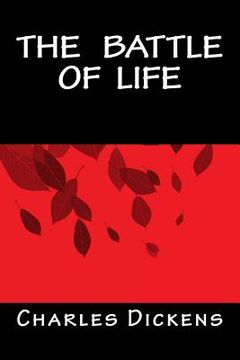
portada The Battle of Life
Type
Physical Book
Illustrated by
Publisher
Language
English
Pages
50
Format
Paperback
Dimensions
22.9 x 15.2 x 0.3 cm
Weight
0.08 kg.
ISBN13
9781535290999

The Battle of Life

Charles Dickens (Author) · Only Books (Illustrated by) · Createspace · Paperback

The Battle of Life - Charles Dickens

New Book Imported to South Africa
Delivery: 20 Aug - 03 Sep Shipping: 17 to 21 business days.
R 359
R 359

Synopsis "The Battle of Life"

The Battle of Life is a Love Story is a novella by Charles Dickens, first published in 1846. It is the fourth of his five "Christmas Books", coming after The Cricket on the Hearth and followed by The Haunted Man and the Ghost's Bargain.The setting is an English village that stands on the site of an historic battle. Some characters refer to the battle as a metaphor for the struggles of life, hence the title.Battle is the only one of the five Christmas Books that has no supernatural or explicitly religious elements. (One scene takes place at Christmas time, but it is not the final scene.) The story bears some resemblance to The Cricket on the Hearth in two respects: it has a non-urban setting, and it is resolved with a romantic twist. It is even less of a social novel than is Cricket. As is typical with Dickens, the ending is a happy one.Two sisters, Grace and Marion, live happily in an English village with their two servants, Clemency Newcome and Ben Britain, and their good-natured widower father Dr Jeddler. Dr Jeddler is a man whose philosophy is to treat life as a farce. Marion, the younger sister, is betrothed to Alfred Heathfield, Jeddler's ward who is leaving the village to complete his studies. He entrusts Marion to Grace's care and makes a promise to return to win Marion's hand.Michael Warden, a libertine who is about to leave the country, is thought by the barristers Snitchey and Craggs to be about to seduce the younger sister into an elopement. Clemency spies Marion one night in her clandestine rendezvous with Warden. On the day that Alfred is to return, however, it is discovered that Marion has run off. Her supposed elopement causes much grief to both her father and her sister.Six years pass. Clemency is now married to Britain and the two have set up a tavern in the village. After nursing heartbreak, Alfred marries Grace instead of Marion and she bears him a daughter, also called Marion. On the birthday of Marion, Grace confides to Alfred that Marion has made a promise to explain her so-called "elopement" in person. Marion indeed appears that evening by sunset and explains her disappearance to the parties involved. It turns out that Marion has not "eloped" but has instead been living at her aunt Martha's place so as to allow Alfred to fall in love with Grace. Tears are shed and happiness and forgiveness reign as the missing sister is reunited with the rest. Warden also returns, and, forgiven by Dr Jeddler, marries Marion.
Charles Dickens
  (Author)
View Author's Page
Charles Dickens (February 7, 1812 - June 9, 1870) was born in Portsmouth and was the eldest son of a Royal Navy clerk. At twelve, his father's imprisonment for debt forced him to work in a blacking factory. His education was sporadic: he taught himself shorthand, worked as a clerk in a law office, and eventually became a parliamentary correspondent for the Morning Chronicle.

Coming from a humble family, "good old Charles" did not receive formal education until he was nine, and was heavily criticized by the critics of the time for being too self-taught. His life took an unexpected turn with his father's imprisonment for debts, moving his family to live with him in jail, allowed at that time by British laws. At the age of 12, he was already considered fit to start working in a dye factory. Although his family's situation had improved, his mother insisted he keep working there, inspiring him to write one of his masterpieces, David Copperfield.

His articles, later collected in Scenes from London Life by "Boz" (1836-1837), were very successful, and with the appearance in 1837 of The Posthumous Papers of the Pickwick Club, Dickens became a true publishing phenomenon. Novels such as Oliver Twist (1837-1839), Nicholas Nickleby (1838-1839), and Barnaby Rudge (1841) gained enormous popularity, as did some travel chronicles, such as Pictures from Italy (1846). With Dombey and Son (1846-1848) he began his mature period, of which good examples are David Copperfield (1849-1850), his first novel in the first person and his favorite, in which he developed some autobiographical episodes; Bleak House (1852-1853); Little Dorrit (1855-1857), A Tale of Two Cities (1859), Great Expectations (1860-1861), and Our Mutual Friend (1864-1865). He died at Gad's Hill, his country house in Higham, in the county of Kent.
See more
See less

Customers reviews

Frequently Asked Questions about the Book

All books in our catalog are Original.
The book is written in English.
The binding of this edition is Paperback.

Questions and Answers about the Book

Do you have a question about the book? Login to be able to add your own question.

Opinions about Bookdelivery

More customer reviews