Tracked shipping to South Africa with premium packaging for just R199 

Ship to
South Africa
0
  • argentina
  • chile
  • colombia
  • españa
  • méxico
  • perú
  • estados unidos
  • internacional

Select your country

Americas

Europe

Rest of the world

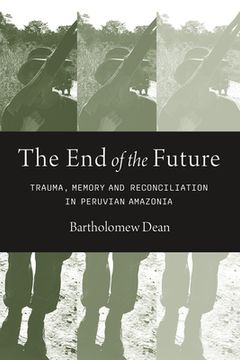
portada The End of the Future: Trauma, Memory, and Reconciliation in Peruvian Amazonia
Type
Physical Book
Preface by
Language
English
Pages
288
Format
Paperback
Dimensions
22.9 x 15.2 x 1.6 cm
Weight
0.42 kg.
ISBN13
9780826506252

The End of the Future: Trauma, Memory, and Reconciliation in Peruvian Amazonia

Bartholomew Dean (Author) · Manuel Burga (Preface by) · Vanderbilt University Press · Paperback

The End of the Future: Trauma, Memory, and Reconciliation in Peruvian Amazonia - Dean, Bartholomew ; Burga, Manuel

New Book Imported to South Africa
Delivery: 06 Aug - 14 Aug Shipping: 5 to 6 business days.
R 905
R 905

Synopsis "The End of the Future: Trauma, Memory, and Reconciliation in Peruvian Amazonia"

In The End of the Future, author Bartholomew Dean broadens the theoretical framework for understanding memory's role in reconciliation following a violent conflict. This book explores the complicated and confusing linkages between memory and trauma for individuals caught up in civil war and post-conflict reconciliation in the Peruvian Amazon's Huallaga Valley--an epicenter for leftist rebels and a booming shadow economy based on the extraction and circulation of cocaine. The End of the Future tells the story of violent attempts by the Túpac Amaru Revolutionary Movement (Movimiento Revolucionario Túpac Amaru, MRTA) to overthrow the state in the late 1980s and early 1990s from the perspective of the poorest residents of the lower Huallaga's Caynarachi Basin. To give context to the causes and consequences of the MRTA's presence in the lower and central Huallaga, this book relies on the written works and testimony of Sístero García Torres, an MRTA rebel commander; the government's Truth and Reconciliation Commission; MRTA propaganda; media accounts; and critical historical texts. Besides exposing Huallaga Valley human rights abuses, the book's contribution to political anthropology is consequential for its insistence that reconciliation is by no means equivalent to local, Indigenous notions of "justice" or customary forms of dispute resolution. Without deliberately addressing the diverse socio-cultural contours defining overlapping epistemologies of justice, freedom, and communal well-being, enduring reconciliation will likely remain elusive.

Customers reviews

Frequently Asked Questions about the Book

All books in our catalog are Original.
The book is written in English.
The binding of this edition is Paperback.

Questions and Answers about the Book

Do you have a question about the book? Login to be able to add your own question.

Opinions about Bookdelivery

More customer reviews