Tracked shipping to South Africa with premium packaging for just R199 

Ship to
South Africa
0
  • argentina
  • chile
  • colombia
  • españa
  • méxico
  • perú
  • estados unidos
  • internacional

Select your country

Americas

Europe

Rest of the world

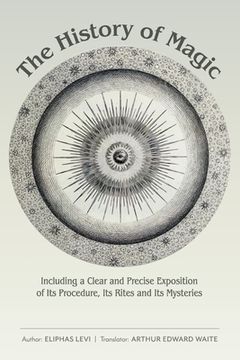
portada The History of Magic: Including a Clear and Precise Exposition of Its Procedure, Its Rites and Its Mysteries
Type
Physical Book
Translated by
Language
English
Pages
430
Format
Paperback
Dimensions
22.9 x 15.2 x 2.4 cm
Weight
0.63 kg.
ISBN13
9781684931859

The History of Magic: Including a Clear and Precise Exposition of Its Procedure, Its Rites and Its Mysteries

Eliphas Lévi (Author) · Arthur Edward Waite (Translated by) · Mockingbird Press · Paperback

The History of Magic: Including a Clear and Precise Exposition of Its Procedure, Its Rites and Its Mysteries - Eliphas Lévi

New Book Imported to South Africa
Delivery: 12 Aug - 20 Aug Shipping: 4 to 5 business days.
R 464
R 464

Synopsis "The History of Magic: Including a Clear and Precise Exposition of Its Procedure, Its Rites and Its Mysteries"

The History of Magic (1913) is an extensive work on the origins of ceremonial magic throughout the world's many cultures and religions. Written by mystic and occultist Éliphas Lévi and translated by British scholar A.E. Waite, this is a foundational book for any student of the occult.French occultist Alphonse Louis Constant (1810-1875) was born in Paris to a shoemaker father. At age 22, he entered the seminary at Saint Sulpice for an education that would prepare him for the priesthood. While he did become ordained a deacon, he found that his doubts regarding the doctrine of the Catholic Church precluded him from completing his ordination. A week before he was due to take orders as a priest, he left the Church and returned to civilian life. Constant worked as a tutor to keep himself afloat, continuing to seek spiritual answers. He was influenced by the work of the mystic Simon Ganneau, a socialist and feminist who advocated gender equality and female emancipation. Constant, too, promoted a vision of an ideal society that would be a utopia for all. His first book, The Bible of Liberty (1851), expounds on these ideas. Unsurprisingly, the French government was highly sensitive to any work that advocated a change in social structure a mere 62 years after the terror of the French Revolution. Constant was arrested immediately and spent six months in prison. He would be imprisoned again four years later for publishing a pamphlet critical of Emperor Napoleon III.Through the 1850s and 1860s, Constant developed and disseminated his growing ideas of the occult, mysticism, and the Kabbalistic school of thought. He became a ceremonial magician and developed a social circle of other mystical and occultist thinkers. He also incorporated Tarot cards into his magic teachings, which is why the Tarot is still considered part of the Western magic tradition.Eschewing the charlatan's tricks and parlor illusions, Lévi believed that the practice of ceremonial magic required a strong will, psychic force, and powerful imagination to discover true science and influence reality. And anyone who attempted to use magic for personal gain would lead to their own destruction. Writing under the name Éliphas Lévi-a literal translation of his name Alphonse Louis into Hebrew-he began to share his ideas on magic with the public. In 1860, he began work on The History of Magic, an assessment and analysis of sacred magic through many past cultures. By exploring the magical components of the pagans, Kabbalists, ancient Greeks, Chinese, Indians, Catholics, and many other groups, Lévi sought to find the secret wisdom hidden within each. He also explored the secret traditions of the Illuminati, Freemasons, and the Knights Templar, among many others. The History of Magic is an essential text for any student of ceremonial magic, revealing the truths behind the fables, allegories, and parables of these cultural traditions. Translated into English by the British poet and mystic A.W. Waite, it was published posthumously in 1913. Waite was one of the creators of the well-known Rider-Waite Tarot Deck, one of the most widely-used tarot decks in the world.The works of Éliphas Lévi would prove to be prime influences on later mystics like Helen Blavatsky, Aleister Crowley, and the Hermetic Order of the Golden Dawn.
Eliphas Lévi
  (Author)
View Author's Page
Eliphas Lévi, pseudonym of Alphonse Louis Constant (1810–1875), was a French occultist, writer, and former seminarian, considered a key figure in the revival of Western esotericism in the 19th century. Although he began his life within Catholicism, he left the priesthood to dedicate himself to writing and esoteric philosophy. His most influential work, *Dogma and Ritual of High Magic* (1854–1856), laid the foundations of modern ceremonial magic. He introduced concepts such as Baphomet and popularized the idea of the “magician” as a spiritual sage. He influenced later occultists like Aleister Crowley and orders like the Golden Dawn. His thought merges Christian symbolism, Kabbalah, alchemy, and astrology.
See more
See less
Arthur Edward Waite
  (Translated by)
View Author's Page
Arthur Edward Waite (October 2, 1867 - May 19, 1942) is considered one of the greatest scholars and experts in occultism and esotericism of recent times. He belonged to various secret orders, such as Freemasonry, the Rosicrucian Order, and the Golden Dawn, and was noted for his deep knowledge of the Kabbalah and Western mystical traditions.

Although he wrote numerous works, his most famous legacy was the creation of the Tarot deck that bears his name, a contribution that consecrated him worldwide.
See more
See less

Customers reviews

Frequently Asked Questions about the Book

All books in our catalog are Original.
The book is written in English.
The binding of this edition is Paperback.

Questions and Answers about the Book

Do you have a question about the book? Login to be able to add your own question.

Opinions about Bookdelivery

More customer reviews