Tracked shipping to South Africa with premium packaging for just R199 

Ship to
South Africa
0
  • argentina
  • chile
  • colombia
  • españa
  • méxico
  • perú
  • estados unidos
  • internacional

Select your country

Americas

Europe

Rest of the world

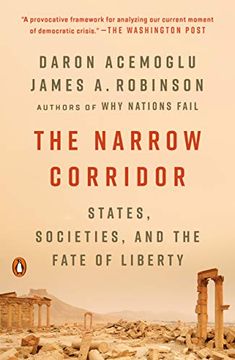
portada The Narrow Corridor: States, Societies, and the Fate of Liberty
Type
Physical Book
Publisher
Year
2020
Language
English
Pages
576
Format
Paperback
Dimensions
21.1x13.7x3.3 cm
Weight
0.48 kg.
ISBN13
9780735224407

The Narrow Corridor: States, Societies, and the Fate of Liberty

Daron Acemoglu (Author) · James A. Robinson (Author) · Penguin · Paperback

The Narrow Corridor: States, Societies, and the Fate of Liberty - James A. Robinson

5 estrellas - de un total de 5 estrellas 1 review
Cheaper New Book Imported to South Africa
Delivery: 09 Oct - 19 Oct Shipping: 5 to 6 business days.
R 331
Faster New Book Imported to South Africa
Delivery: 07 Oct - 16 Oct Shipping: 3 to 5 business days.
R 372
R 331

Synopsis "The Narrow Corridor: States, Societies, and the Fate of Liberty "

From the authors of the international bestseller Why Nations Fail, a crucial new big-picture framework that answers the question of how liberty flourishes in some states but falls to authoritarianism or anarchy in others--and explains how it can continue to thrive despite new threats. In Why Nations Fail, Daron Acemoglu and James A. Robinson argued that countries rise and fall based not on culture, geography, or chance, but on the power of their institutions. In their new book, they build a new theory about liberty and how to achieve it, drawing a wealth of evidence from both current affairs and disparate threads of world history.   Liberty is hardly the "natural" order of things. In most places and at most times, the strong have dominated the weak and human freedom has been quashed by force or by customs and norms. Either states have been too weak to protect individuals from these threats, or states have been too strong for people to protect themselves from despotism. Liberty emerges only when a delicate and precarious balance is struck between state and society. There is a Western myth that political liberty is a durable construct, arrived at by a process of "enlightenment." This static view is a fantasy, the authors argue. In reality, the corridor to liberty is narrow and stays open only via a fundamental and incessant struggle between state and society: The authors look to the American Civil Rights Movement, Europe&;s early and recent history, the Zapotec civilization circa 500 BCE, and Lagos&;s efforts to uproot corruption and institute government accountability to illustrate what it takes to get and stay in the corridor. But they also examine Chinese imperial history, colonialism in the Pacific, India&;s caste system, Saudi Arabia&;s suffocating cage of norms, and the &;Paper Leviathan&; of many Latin American and African nations to show how countries can drift away from it, and explain the feedback loops that make liberty harder to achieve. Today we are in the midst of a time of wrenching destabilization. We need liberty more than ever, and yet the corridor to liberty is becoming narrower and more treacherous. The danger on the horizon is not "just" the loss of our political freedom, however grim that is in itself; it is also the disintegration of the prosperity and safety that critically depend on liberty. The opposite of the corridor of liberty is the road to ruin.
Daron Acemoglu
  (Author)
View Author's Page
He is a Professor of Economics and holds the Elizabeth and James Killian Chair at the Massachusetts Institute of Technology (MIT).
In 2005, he received the John Bates Clark Medal, awarded to economists under forty who have made significant contributions to economic thought and knowledge. In 2010, Foreign Policy magazine named him one of the 100 most influential thinkers.
His main interests are political economy, development economics, economic growth, technology, income and wage inequality, human capital and training, and labor economics. His most recent works focus on the role of institutions in economic development and political economy.
See more
See less
James A. Robinson
  (Author)
View Author's Page
He is a political scientist, economist, and professor at the University of Chicago. An expert on Latin America and Africa, he is currently conducting his research in Bolivia, the Democratic Republic of the Congo, Sierra Leone, Haiti, and Colombia, where he has taught for many years during the summer at the Universidad de los Andes in Bogotá.

He is co-author, along with Daron Acemoglu, of the bestseller Why Nations Fail (Deusto, 2012), which analyzes why some countries experience economic growth while others fall into poverty.
See more
See less

Customers reviews

Darwin Cortes Thursday, January 12, 2023
Verified Purchase

excelente

00
  • 100% (1)
  • 0% (0)
  • 0% (0)
  • 0% (0)
  • 0% (0)

Frequently Asked Questions about the Book

All books in our catalog are Original.
The book is written in English.
The binding of this edition is Paperback.

Questions and Answers about the Book

Do you have a question about the book? Login to be able to add your own question.

Opinions about Bookdelivery

More customer reviews