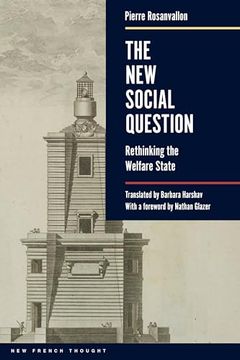
The new Social Question: Rethinking the Welfare State (New French Thought Series, 4)
Pierre Rosanvallon
Synopsis "The new Social Question: Rethinking the Welfare State (New French Thought Series, 4)"
How social and intellectual changes undermine our justifications for the welfare state The welfare state has come under severe pressure internationally, partly for the well-known reasons of slowing economic growth and declining confidence in the public sector. According to the influential social theorist Pierre Rosanvallon, however, there is also a deeper and less familiar reason for the crisis of the welfare state. He shows here that a fundamental practical and philosophical justification for traditional welfare policies--that all citizens share equal risks--has been undermined by social and intellectual change. If we wish to achieve the goals of social solidarity and civic equality for which the welfare state was founded, Rosanvallon argues, we must radically rethink social programs. Rosanvallon begins by tracing the history of the welfare state and its founding premise that risks, especially the risks of illness and unemployment, are equally distributed and unpredictable. He shows that this idea has become untenable because of economic diversification and advances in statistical and risk analysis. It is truer than ever before--and far more susceptible to analysis--that some individuals will face much greater risks than others because of their jobs and lifestyle choices. Rosanvallon argues that social policies must be more narrowly targeted. And he draws on evidence from around the world, in particular France and the United States, to show that such programs as unemployment insurance and workfare could better reflect individual needs by, for example, making more explicit use of contracts between the providers and receivers of benefits. His arguments have broad implications for welfare programs everywhere and for our understanding of citizenship in modern democracies and economies.
Pierre Rosanvallon, nacido en 1948 en Blois, Francia, es un destacado historiador, sociólogo y teórico político francés. Se formó en instituciones académicas de élite, donde combinó historia, ciencias sociales y economía, lo que le permitió desarrollar un enfoque interdisciplinario para estudiar la política y la sociedad. A lo largo de su carrera, se ha centrado en temas como la historia de la democracia, el papel del Estado, la justicia social y los desafíos de la representación política en las sociedades modernas.
En sus primeros años profesionales, Rosanvallon exploró la autogestión y las dinámicas laborales, antes de dedicarse plenamente a la investigación y la docencia. Ha ocupado la cátedra de historia moderna y contemporánea de lo político en el Collège de France y es director de estudios en la École des hautes études en sciences sociales. Además, fundó La République des Idées, un espacio para promover el debate público y la reflexión sobre los problemas sociales y políticos contemporáneos.
Rosanvallon ha escrito numerosas obras influyentes en las que analiza la legitimidad democrática, la gobernanza, la confianza institucional y los desafíos de la participación ciudadana. Su trabajo combina rigor histórico con reflexión teórica, y ha influido en académicos y responsables políticos de todo el mundo. Es considerado una de las voces más importantes en la teoría política moderna, aportando perspectivas innovadoras sobre cómo se ejerce el poder y cómo se construyen las sociedades democráticas.