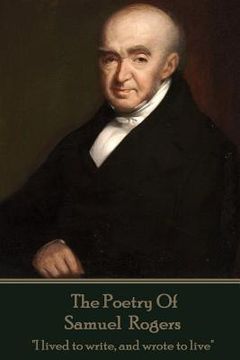
The Poetry Of Samuel Rogers: "I lived to write, and wrote to live"
Rogers, Samuel
Synopsis "The Poetry Of Samuel Rogers: "I lived to write, and wrote to live""
Samuel Rogers was born on 30th July 1763 at Newington Green, at the time a village north of Islington, London and was educated in Hackney and Stoke Newington. Although Rogers wished to enter the Presbyterian ministry, his father persuaded him to join the family banking business in Cornhill. He complied with his fathers' wishes but his frail health provided an excuse to take time off from work and much of this time was spent on a steadily growing interest in English literature, particularly the works of Samuel Johnson, Thomas Gray and Oliver Goldsmith. His circumstances now allowed him to try writing poetry himself. He began with contributions to the Gentleman's Magazine, and in 1786 he published a volume containing some imitations of Goldsmith and an "Ode to Superstition" in the style of Gray. In 1788 his elder brother sadly Thomas died, and Rogers was called upon to increase his responsibilities to the family business. However, Rogers still set aside time to work on his poetry. Using Gray as his model (who was exceedingly slow at producing finished poems), Rogers spent much time polishing his verses, and it was six years after the publication of his first volume before he published his next: The Pleasures of Memory in 1792. In 1793 his father died and Rogers now inherited the principal share of the banking house in Cornhill, and attached to it was a considerable income. Rogers could now use both his business influence, power and money with that of his literary career and conversational ability to be at the very centre of literary and social London. It was a role in which he was masterful. At the time social breakfasts were very popular in London. Rogers was a noted host of these and many clamoured for his attention, eye and an invitation. His dinner parties were open to only a very select few. His powers as a conversationalist, his educated taste in all matters of art, and his sarcastic and bitter wit, for which he excused himself by saying that he had such a small voice that no one listened if he said pleasant things, combined to make him perhaps London's most powerful host. "He certainly had the kindest heart and unkindest tongue of any one I ever knew," said Fanny Kemble. He helped the Francis Jeffrey reconcile with Byron, and he relieved Sheridan's difficulties in the last days of his life. The Irish poet, Thomas Moore, who refused help from everyone, and would only owe debts to his publishers, found it possible to accept help from Rogers. He also procured a pension for HF Cary, the translator of Dante, and obtained for Wordsworth his sinecure as distributor of stamps. Rogers made his poetic reputation with The Pleasures of Memory when William Cowper's fame was still in the making. As well as friendships with Wordsworth, Walter Scott and Byron, he was asked for, on the death of Wordsworth, and after declining the post for himself, his opinion on the fitness of Alfred Tennyson for the post of Poet Laureate. Rogers was held in high esteem by many other institutions. He was a trustee of the National Gallery; and he served on a commission regarding the management of the British Museum, and yet another for the rebuilding of the Houses of Parliament. In November 1796 he was elected a Fellow of the Royal Society. Rogers then followed the same treatment with an equally sumptuous edition of his Poems in 1834. For the last five years of his life he was confined to his chair in consequence of a fall in the street. He died in London at age 92 on 18th December 1855, and is buried in the family tomb in the churchyard of St Mary's Church, Hornsey High Street, Haringey.