Tracked shipping to South Africa with premium packaging for just R199 

Ship to
South Africa
0
  • argentina
  • chile
  • colombia
  • españa
  • méxico
  • perú
  • estados unidos
  • internacional

Select your country

Americas

Europe

Rest of the world

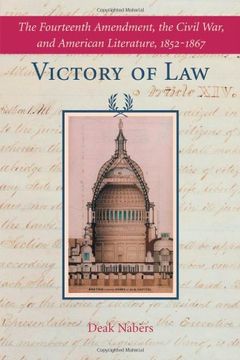
portada Victory of Law: The Fourteenth Amendment, the Civil War, and American Literature, 1852–1867

Victory of Law: The Fourteenth Amendment, the Civil War, and American Literature, 1852–1867

Deak Nabers (Author) · Johns Hopkins University Press · Hardcover

Victory of Law: The Fourteenth Amendment, the Civil War, and American Literature, 1852–1867 - Deak Nabers

New Book Imported to South Africa
Delivery: 24 Nov - 30 Nov Shipping: 13 to 14 business days.
R 1,025
R 1,025

Synopsis "Victory of Law: The Fourteenth Amendment, the Civil War, and American Literature, 1852–1867 "

In Victory of Law, Deak Nabers examines developing ideas about the nature of law as reflected in literary and political writing before, during, and after the American Civil War. Nabers traces the evolution of antislavery thought from its pre-war opposition to the constitutional order of the young nation to its ultimate elevation of the U.S. Constitution as an expression of the ideal of justice―an ideal embodied in the Fourteenth Amendment. Nabers shows how the intellectual history of the Fourteenth Amendment was rooted in literary sources―including Herman Melville’s Battle-Pieces, Harriet Beecher Stowe’s Uncle Tom’s Cabin, and William Wells Brown’s Clotel―as well as in legal texts such as Somerset v. Stewart, Dred Scott v. Sandford, and Charles Sumner’s "Freedom National" address. Not only were prominent writers like Ralph Waldo Emerson and Frederick Douglass instrumental in remapping the relations between law and freedom, but figures like Sumner and John Bingham helped develop a systematic antislavery reading of the Constitution which established literary texts as sources for legal authority. This interdisciplinary study sheds light on the transformative significance of emerging legalist and constitutionalist forms of antislavery thinking on the literature of the 1850s and 1860s and the growing centrality of aesthetic considerations to antebellum American legal theory and practice―the historical terms in which a distinctively American cultural identity was conceived.

Customers reviews

Frequently Asked Questions about the Book

All books in our catalog are Original.
The book is written in English.
The binding of this edition is Hardcover.

Questions and Answers about the Book

Do you have a question about the book? Login to be able to add your own question.

Opinions about Bookdelivery

More customer reviews