Tracked shipping to South Africa with premium packaging for just R199 

Ship to
South Africa
0
  • argentina
  • chile
  • colombia
  • españa
  • méxico
  • perú
  • estados unidos
  • internacional

Select your country

Americas

Europe

Rest of the world

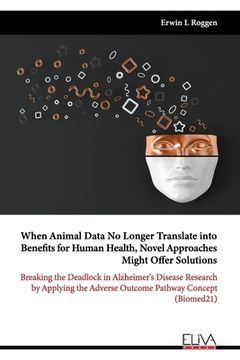
portada When Animal Data No Longer Translate into Benefits for Human Health, Novel Approaches Might Offer Solutions: Breaking the Deadlock in Alzheimer's Dise
Type
Physical Book
Publisher
Language
English
Pages
74
Format
Paperback
Dimensions
22.9 x 15.2 x 0.4 cm
Weight
0.11 kg.
ISBN13
9781636485614

When Animal Data No Longer Translate into Benefits for Human Health, Novel Approaches Might Offer Solutions: Breaking the Deadlock in Alzheimer's Dise

Erwin L. Roggen (Author) · Eliva Press · Paperback

When Animal Data No Longer Translate into Benefits for Human Health, Novel Approaches Might Offer Solutions: Breaking the Deadlock in Alzheimer's Dise - Roggen, Erwin L.

New Book Imported to South Africa
Delivery: 24 Aug - 02 Sep Shipping: 4 to 5 business days.
R 862
R 862

Synopsis "When Animal Data No Longer Translate into Benefits for Human Health, Novel Approaches Might Offer Solutions: Breaking the Deadlock in Alzheimer's Dise"

For decades research has relied on animal models to acquire understanding of pathological processes and to identify targets for drug development. It cannot be denied that ground-breaking and Nobel prize winning results were obtained, but this era of glory seems to be over as the low hanging fruits have been taken. Indeed, looking back at the last two decades of research into the pathologic processes leading to cancer, neurodegeneration and arthrosclerosis, failure rates with respect to translation into human benefit, were 80%, 99% and 100%, despite huge investments. During the BioMed21 workshops federal agencies, funding agencies, regulators, and academics explored existing approaches and potential improvements in development, access, storage, and evaluation of human-relevant information with the goal of enhancing human disease research. One recommendation is the adaptation of the Adverse Outcome Pathway (AOP) concept for mapping perturbations of normal human physiology during disease development. The AOP concept, currently applied in toxicology, has since been being applied to capture complex biological knowledge about non-communicable and communicable human diseases. It is believed that this approach can enable new target discovery as exemplified by the AOP for developmental vascular toxicity (AOP43). In this book it is described how the AOP concept can be used to build AOPs and AOP networks, as well as gene interaction networks, providing new insight into the early processes driving memory loss and the impact of environmental factors on these processes translates into accelerated deterioration of these aging-related processes towards Alzheimer's related dementia.

Customers reviews

Frequently Asked Questions about the Book

All books in our catalog are Original.
The book is written in English.
The binding of this edition is Paperback.

Questions and Answers about the Book

Do you have a question about the book? Login to be able to add your own question.

Opinions about Bookdelivery

More customer reviews