Tracked shipping to South Africa with premium packaging for just R199 

Ship to
South Africa
0
  • argentina
  • chile
  • colombia
  • españa
  • méxico
  • perú
  • estados unidos
  • internacional

Select your country

Americas

Europe

Rest of the world

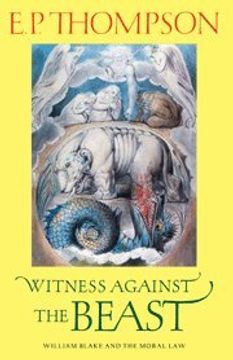
portada Witness Against the Beast Hardback: William Blake and the Moral law
Type
Physical Book
Year
1993
Language
English
Pages
284
Format
Hardcover
Dimensions
21.6 x 14.0 x 1.9 cm
Weight
0.51 kg.
ISBN
0521225159
ISBN13
9780521225151
Edition No.
1

Witness Against the Beast Hardback: William Blake and the Moral law

E. P. Thompson (Author) · Christopher Hill (Preface by) · Cambridge University Press · Hardcover

Witness Against the Beast Hardback: William Blake and the Moral law - Christopher Hill

New Book Imported to South Africa
Delivery: 13 Aug - 21 Aug Shipping: 4 to 5 business days.
R 2,662
R 2,662

Synopsis "Witness Against the Beast Hardback: William Blake and the Moral law "

E. P. Thompson's long-awaited book on William Blake was published shortly after the historian's death in August 1993. Acclaimed as one of his best and most deeply felt works, it appears now for the first time in paperback. Written with a vivid passion, and bearing the marks of Thompson's lifelong struggle against authoritarian and anti-humanitarian politics both at the level of the individual and of the state, Witness Against the Beast: William Blake and the Moral Law is a profound enquiry into the structure of Blake's thought and the character of his sensibility. Its qualities are among those which place Thompson himself in the same tradition of dissenting values and non-conforming radicalism represented by Blake some two hundred years earlier.
E. P. Thompson
  (Author)
View Author's Page
E. P. Thompson, full name (seldom used) Edward Palmer Thompson (1924-1993). British historian and intellectual. He decisively influenced British Marxist thought, distinguishing it from European Marxism and giving it a unique character, within what is known as humanist socialism. Born in Oxford to Methodist missionary parents. Fought in World War II, in a tank company in Italy. Studied at Corpus Christi College, Cambridge. Politically committed to the left and pacifism, in 1946 he formed the Communist Party Historians Group or Cambridge Group, with Christopher Hill, Eric Hobsbawn, Rodney Hilton, Dona Torr, and others. In 1948 he married Dorothy Towers, also a historian of the same trend. The group was centered around the journal Past and Present from 1952, and survived his departure from the Communist Party (1956, following the Soviet invasion of Hungary). Played a key role in the early days of the movement known as the New Left in the late 1950s. He was noted for his critical stance from the left against the Labour governments of 1964-1970 and 1974-1979. During the 1980s he led the movement of intellectuals against nuclear weapons in Europe. He intervened in opening dialogue between the Western European pacifist movement and dissidents from Eastern Europe dominated by the Soviet Union, for which he was accused by the latter of acting in the service of American imperialism. Professor at various universities in England and the United States, his loud departure from the University of Warwick in protest against its commercialization (which he recounts in his book Warwick University Limited, 1971) was notable. He attacked the structuralist Marxism of Louis Althusser and his British followers from the New Left Review (a magazine and movement from which Thompson had distanced himself from its second period, which included elements close to Trotskyism). This episode sparked a juicy historiographical debate, with cross-contributions between himself (The Poverty of Theory, 1978) and New Left, with Perry Anderson at the forefront (Discussions/arguments within English Marxism, playing with the word Arguments). His historiographical production focuses on social history, especially on the working-class movement of industrial revolution England. Prolific essayist and columnist, he also published influential biographies of William Morris and William Blake. His essential work is The Making of the English Working Class (1963), where he revises the traditional Marxist interpretation from a non-dogmatic historical materialism.
See more
See less

Christopher Hill
  (Preface by)
View Author's Page
Christopher Hill (1912-2003) fue un influyente historiador marxista británico, conocido por su profundo estudio de la Revolución Inglesa del siglo XVII y su enfoque en la "historia desde abajo", resaltando los movimientos radicales y utópicos de la época, como los Diggers y Levellers, vinculando su legado con el presente, y fue Rector del Balliol College de Oxford, dejando obras clave como El siglo de la revolución y El mundo trastornado
See more
See less

Customers reviews

Frequently Asked Questions about the Book

All books in our catalog are Original.
The book is written in English.
The binding of this edition is Hardcover.

Questions and Answers about the Book

Do you have a question about the book? Login to be able to add your own question.

Opinions about Bookdelivery

More customer reviews