
Jose Enrique Rodo
José Enrique Rodó (Montevideo, July 15, 1871 – Palermo, Italy, May 1, 1917) was a Uruguayan writer, essayist, and politician, noted as one of the most influential figures in Latin American literary modernism. His work is marked by a deep commitment to Hispanic American cultural identity and a critique of utilitarianism and the influence of Anglo-Saxon culture in the region
Son of José Rodó and Rosario Piñeyro, Rodó showed from an early age a great aptitude for reading and writing. At 14, after his father's death, he began working as an assistant in a notary's office. Despite not having completed his university studies, his literary talent allowed him to access the chair of Literature at the University of Montevideo in 1898
In 1900 he published his best-known work, Ariel, a philosophical essay that became a reference in Latin American thought. In it, he uses characters from Shakespeare's The Tempest—Prospero, Ariel, and Caliban—to represent values such as wisdom, idealism, and materialism, respectively. Through this symbolism, Rodó advocates for an education based on humanist values and a critique of the utilitarian materialism of North American culture
In addition to his literary work, Rodó was an active political and cultural figure. He founded in 1895 the National Review of Literature and Social Sciences and was a deputy of the Colorado Party between 1902 and 1907. His thought influenced movements such as the University Reform of 1918 and general Latin American cultural criticism
Rodó died in 1917 in Palermo, Italy, while serving as a correspondent for the Argentine magazine Caras y Caretas. His legacy endures in Latin American literature and thought, being considered one of the great thinkers and writers of the region
Son of José Rodó and Rosario Piñeyro, Rodó showed from an early age a great aptitude for reading and writing. At 14, after his father's death, he began working as an assistant in a notary's office. Despite not having completed his university studies, his literary talent allowed him to access the chair of Literature at the University of Montevideo in 1898
In 1900 he published his best-known work, Ariel, a philosophical essay that became a reference in Latin American thought. In it, he uses characters from Shakespeare's The Tempest—Prospero, Ariel, and Caliban—to represent values such as wisdom, idealism, and materialism, respectively. Through this symbolism, Rodó advocates for an education based on humanist values and a critique of the utilitarian materialism of North American culture
In addition to his literary work, Rodó was an active political and cultural figure. He founded in 1895 the National Review of Literature and Social Sciences and was a deputy of the Colorado Party between 1902 and 1907. His thought influenced movements such as the University Reform of 1918 and general Latin American cultural criticism
Rodó died in 1917 in Palermo, Italy, while serving as a correspondent for the Argentine magazine Caras y Caretas. His legacy endures in Latin American literature and thought, being considered one of the great thinkers and writers of the region
See more
See less
Jose Enrique Rodo Books
See:Physical Books
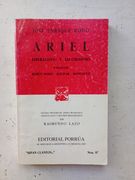
![Ariel [Edicion de Belen Castro] (in Spanish)](https://images.cdn3.buscalibre.com/fit-in/180x180/d5/b8/d5b8808e84cf37e1588b614c08598a8c.jpg)



Few books have been found. You can Repeat Search without requiring all the searched terms to be present..