Tracked shipping to South Africa with premium packaging for just R199 

Ship to
South Africa
0
  • argentina
  • chile
  • colombia
  • españa
  • méxico
  • perú
  • estados unidos
  • internacional

Select your country

Americas

Europe

Rest of the world

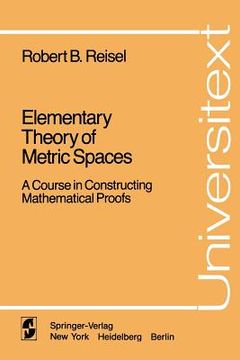
portada elementary theory of metric spaces: a course in constructing mathematical proofs
Type
Physical Book
Publisher
Year
1998
Language
English
Pages
120
Format
Hardcover
Dimensions
23.4 x 15.6 x 0.7 cm
Weight
0.20 kg.
ISBN
0387907068
ISBN13
9780387907062

elementary theory of metric spaces: a course in constructing mathematical proofs

Robert B. Reisel (Author) · Springer · Hardcover

elementary theory of metric spaces: a course in constructing mathematical proofs - Reisel, Robert B.

Cheaper New Book Imported to South Africa
Delivery: 28 Aug - 11 Sep Shipping: 12 to 16 business days.
R 1,422
Faster New Book Imported to South Africa
Delivery: 18 Aug - 26 Aug Shipping: 4 to 5 business days.
R 1,772
R 1,422

Synopsis "elementary theory of metric spaces: a course in constructing mathematical proofs"

Science students have to spend much of their time learning how to do laboratory work, even if they intend to become theoretical, rather than experimental, scientists. It is important that they understand how experiments are performed and what the results mean. In science the validity of ideas is checked by experiments. If a new idea does not work in the laboratory, it must be discarded. If it does work, it is accepted, at least tentatively. In science, therefore, laboratory experiments are the touchstones for the acceptance or rejection of results. Mathematics is different. This is not to say that experiments are not part of the subject. Numerical calculations and the examina- tion of special and simplified cases are important in leading mathematicians to make conjectures, but the acceptance of a conjecture as a theorem only comes when a proof has been constructed. In other words, proofs are to mathematics as laboratory experiments are to science. Mathematics students must, therefore, learn to know what constitute valid proofs and how to construct them. How is this done? Like everything else, by doing. Mathematics students must try to prove results and then have their work criticized by experienced mathematicians. They must critically examine proofs, both correct and incorrect ones, and develop an appreciation of good style. They must, of course, start with easy proofs and build to more complicated ones.

Customers reviews

Frequently Asked Questions about the Book

All books in our catalog are Original.
The book is written in English.
The binding of this edition is Hardcover.

Questions and Answers about the Book

Do you have a question about the book? Login to be able to add your own question.

Opinions about Bookdelivery

More customer reviews