Tracked shipping to South Africa with premium packaging for just R199 

Ship to
South Africa
0
  • argentina
  • chile
  • colombia
  • españa
  • méxico
  • perú
  • estados unidos
  • internacional

Select your country

Americas

Europe

Rest of the world

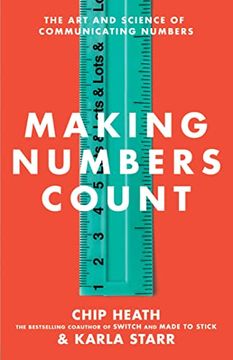
portada Making Numbers Count: The art and Science of Communicating Numbers
Type
Physical Book
Year
2022
Language
English
Pages
208
Format
Hardcover
Dimensions
21.6x14.5x2.5 cm
Weight
0.39 kg.
ISBN13
9781982165444

Making Numbers Count: The art and Science of Communicating Numbers

Chip Heath (Author) · Karla Starr (Author) · Avid Reader Press / Simon & Schuster · Hardcover

Making Numbers Count: The art and Science of Communicating Numbers - Chip Heath

Cheaper New Book Imported to South Africa
Delivery: 15 Oct - 28 Oct Shipping: 14 to 18 business days.
R 466
Faster New Book Imported to South Africa
Delivery: 09 Oct - 23 Oct Shipping: 10 to 15 business days.
R 764
R 466

Synopsis "Making Numbers Count: The art and Science of Communicating Numbers "

A clear, practical, first-of-its-kind guide to communicating and understanding numbers and data--from bestselling business author Chip Heath. How much bigger is a billion than a million? Well, a million seconds is twelve days. A billion seconds is...thirty-two years. Understanding numbers is essential--but humans aren't built to understand them. Until very recently, most languages had no words for numbers greater than five--anything from six to infinity was known as "lots." While the numbers in our world have gotten increasingly complex, our brains are stuck in the past. How can we translate millions and billions and milliseconds and nanometers into things we can comprehend and use? Author Chip Heath has excelled at teaching others about making ideas stick and here, in Making Numbers Count, he outlines specific principles that reveal how to translate a number into our brain's language. This book is filled with examples of extreme number makeovers, vivid before-and-after examples that take a dry number and present it in a way that people click in and say "Wow, now I get it!" You will learn principles such as: -SIMPLE PERSPECTIVE CUES: researchers at Microsoft found that adding one simple comparison sentence doubled how accurately users estimated statistics like population and area of countries. -VIVIDNESS: get perspective on the size of a nucleus by imagining a bee in a cathedral, or a pea in a racetrack, which are easier to envision than "1/100,000th of the size of an atom." -CONVERT TO A PROCESS: capitalize on our intuitive sense of time (5 gigabytes of music storage turns into "2 months of commutes, without repeating a song"). -EMOTIONAL MEASURING STICKS: frame the number in a way that people already care about ("that medical protocol would save twice as many women as curing breast cancer"). Whether you're interested in global problems like climate change, running a tech firm or a farm, or just explaining how many Cokes you'd have to drink if you burned calories like a hummingbird, this book will help math-lovers and math-haters alike translate the numbers that animate our world--allowing us to bring more data, more naturally, into decisions in our schools, our workplaces, and our society.
Chip Heath
  (Author)
View Author's Page
Heath is an emeritus professor of Organizational Behavior at the Thrive Foundation for Youth at the Stanford Graduate School of Business. His research examines why certain ideas—from urban legends to home remedies, from "Chicken Soup for the Soul" stories to business strategy myths—survive and thrive in the social marketplace of ideas. A few years ago, Heath designed a course, now a popular elective at Stanford, that explored the possibility of using the principles of naturally sticky ideas to design more effective messages. The material from that course, "How to Make Ideas Stick", has been taught to hundreds of students, including managers, professors, nonprofit leaders, doctors, journalists, venture capitalists, product designers, and film producers.

Heath co-authored (with his brother, Dan) a book titled Made to Stick: Why Some Ideas Survive and Others Die, published by Random House in January 2007.

Heath's research has appeared in Organizational Behavior and Human Decision Processes, Quarterly Journal of Economics, Cognitive Psychology, Journal of Consumer Behavior, Strategic Management Journal, Psychological Science, and Journal of Risk and Uncertainty. Popular articles about his research have been published in Scientific American, Financial Times, Washington Post, Business Week, Psychology Today, Vanity Fair, NPR, and a National Geographic television program.

Heath has taught courses on organizational behavior, negotiation, strategy, international strategy, and social entrepreneurship. Before joining Stanford, he taught at the University of Chicago Graduate School of Business and Duke University's Fuqua School of Business. He earned his bachelor's degree in industrial engineering from Texas A&M University and his PhD in psychology from Stanford.
See more
See less

Customers reviews

Frequently Asked Questions about the Book

All books in our catalog are Original.
The book is written in English.
The binding of this edition is Hardcover.

Questions and Answers about the Book

Do you have a question about the book? Login to be able to add your own question.

Opinions about Bookdelivery

More customer reviews