Tracked shipping to South Africa with premium packaging for just R199 

Ship to
South Africa
0
  • argentina
  • chile
  • colombia
  • españa
  • méxico
  • perú
  • estados unidos
  • internacional

Select your country

Americas

Europe

Rest of the world

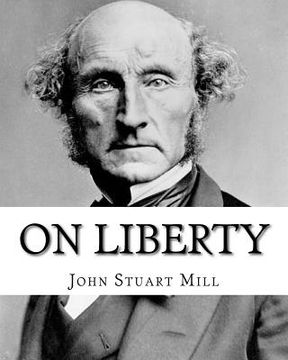
portada On Liberty By: John Stuart Mill: On Liberty is a philosophical work in the English language by 19th century philosopher John Stuart M
Type
Physical Book
Publisher
Language
English
Pages
74
Format
Paperback
Dimensions
25.4x20.3x0.4 cm
Weight
0.16 kg.
ISBN13
9781719158152

On Liberty By: John Stuart Mill: On Liberty is a philosophical work in the English language by 19th century philosopher John Stuart M

John Stuart Mill (Author) · Createspace · Paperback

On Liberty By: John Stuart Mill: On Liberty is a philosophical work in the English language by 19th century philosopher John Stuart M - John Stuart Mill

New Book Imported to South Africa
Delivery: 11 Dec - 22 Dec Shipping: 16 to 20 business days.
R 336
R 336

Synopsis "On Liberty By: John Stuart Mill: On Liberty is a philosophical work in the English language by 19th century philosopher John Stuart M"

On Liberty is a philosophical work by the English philosopher John Stuart Mill, originally intended as a short essay. The work, published in 1859, applies Mill's ethical system of utilitarianism to society and the state.Mill attempts to establish standards for the relationship between authority and liberty. He emphasizes the importance of individuality, which he conceived as a prerequisite to the higher pleasures-the summum bonum of utilitarianism. Furthermore, Mill criticizes the errors of past attempts to defend individuality where, for example, democratic ideals resulted in the "tyranny of the majority". Among the standards established in this work are Mill's three basic liberties of individuals, his three legitimate objections to government intervention, and his two maxims regarding the relationship of the individual to society. On Liberty was a greatly influential and well received work, although it did not go without criticism. Some attacked it for its apparent discontinuity with Utilitarianism, while others criticized its vagueness. The ideas presented in On Liberty have remained the basis of much liberal political thought. It has remained in print continuously since its initial publication. To this day, a copy of On Liberty is passed to the president of the British Liberal Democrats as a symbol of office. A copy of the same book is also presented to and then held by the president of the Liberal Party as a symbol of office. Mill's marriage to his wife Harriet Taylor Mill greatly influenced the concepts in On Liberty, which was largely finished prior to her death, and published shortly after she died.............. John Stuart Mill (20 May 1806 - 8 May 1873) was a British philosopher, political economist and civil servant. One of the most influential thinkers in the history of liberalism, he contributed widely to social theory, political theory and political economy. Dubbed "the most influential English-speaking philosopher of the nineteenth century", Mill's conception of liberty justified the freedom of the individual in opposition to unlimited state and social control. Mill was a proponent of utilitarianism, an ethical theory developed by his predecessor Jeremy Bentham. He contributed to the investigation of scientific methodology, though his knowledge of the topic was based on the writings of others, notably William Whewell, John Herschel and Auguste Comte, and research carried out for Mill by Alexander Bain. Mill engaged in written debate with Whewell.[8] A member of the Liberal Party, he was also the first Member of Parliament to call for women's suffrage. Works: A System of Logic Main article: A System of Logic Mill joined the debate over scientific method which followed on from John Herschel's 1830 publication of A Preliminary Discourse on the study of Natural Philosophy, which incorporated inductive reasoning from the known to the unknown, discovering general laws in specific facts and verifying these laws empirically. William Whewell expanded on this in his 1837 History of the Inductive Sciences, from the Earliest to the Present Time followed in 1840 by The Philosophy of the Inductive Sciences, Founded Upon their History, presenting induction as the mind superimposing concepts on facts. Laws were self-evident truths, which could be known without need for empirical verification.....
John Stuart Mill
  (Author)
View Author's Page
John Stuart Mill (1806-1873) was a British philosopher, economist, and politician, considered a key figure in liberalism and utilitarianism. Influenced by Jeremy Bentham and his father, James Mill, he wrote extensively on freedom, economy, and social justice. Among his most notable works are On Liberty (1859), where he defends individual rights against state control, and Utilitarianism (1863), where he develops this philosophical current.

His work also covered political economy with Principles of Political Economy (1848) and the philosophy of law with Representative Government (1861). Additionally, in The Subjection of Women (1869) he advocated for gender equality. His thinking continues to influence contemporary political philosophy and social theory.
See more
See less

Customers reviews

Frequently Asked Questions about the Book

All books in our catalog are Original.
The book is written in English.
The binding of this edition is Paperback.

Questions and Answers about the Book

Do you have a question about the book? Login to be able to add your own question.

Opinions about Bookdelivery

More customer reviews