Tracked shipping to South Africa with premium packaging for just R199 

Ship to
South Africa
0
  • argentina
  • chile
  • colombia
  • españa
  • méxico
  • perú
  • estados unidos
  • internacional

Select your country

Americas

Europe

Rest of the world

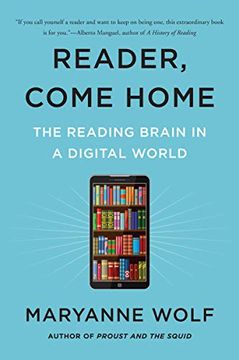
portada Reader, Come Home: The Reading Brain in a Digital World
Type
Physical Book
Year
2019
Language
English
Pages
288
Format
Paperback
Dimensions
20.3x13.7x1.8 cm
Weight
0.23 kg.
ISBN13
9780062388773

Reader, Come Home: The Reading Brain in a Digital World

Maryanne Wolf (Author) · Harper Paperbacks · Paperback

Reader, Come Home: The Reading Brain in a Digital World - Maryanne Wolf

New Book Imported to South Africa
Delivery: 07 Oct - 15 Oct Shipping: 5 to 6 business days.
R 364
R 364

Synopsis "Reader, Come Home: The Reading Brain in a Digital World "

The author of the acclaimed Proust and the Squid follows up with a lively, ambitious, and deeply informative book that considers the future of the reading brain and our capacity for critical thinking, empathy, and reflection as we become increasingly dependent on digital technologies.A decade ago, Maryanne Wolf's Proust and the Squid revealed what we know about how the brain learns to read and how reading changes the way we think and feel. Since then, the ways we process written language have changed dramatically with many concerned about both their own changes and that of children. New research on the reading brain chronicles these changes in the brains of children and adults as they learn to read while immersed in a digitally dominated medium.Drawing deeply on this research, this book comprises a series of letters Wolf writes to us--her beloved readers--to describe her concerns and her hopes about what is happening to the reading brain as it unavoidably changes to adapt to digital mediums. Wolf raises difficult questions, including: Will children learn to incorporate the full range of "deep reading" processes that are at the core of the expert reading brain?Will the mix of a seemingly infinite set of distractions for children's attention and their quick access to immediate, voluminous information alter their ability to think for themselves?With information at their fingertips, will the next generation learn to build their own storehouse of knowledge, which could impede the ability to make analogies and draw inferences from what they know?Will all these influences change the formation in children and the use in adults of "slower" cognitive processes like critical thinking, personal reflection, imagination, and empathy that comprise deep reading and that influence both how we think and how we live our lives?How can we preserve deep reading processes in future iterations of the reading brain?Concerns about attention span, critical reasoning, and over-reliance on technology are never just about children--Wolf herself has found that, though she is a reading expert, her ability to read deeply has been impacted as she has become increasingly dependent on screens.Wolf draws on neuroscience, literature, education, and philosophy and blends historical, literary, and scientific facts with down-to-earth examples and warm anecdotes to illuminate complex ideas that culminate in a proposal for a biliterate reading brain. Provocative and intriguing, Reader, Come Home is a roadmap that provides a cautionary but hopeful perspective on the impact of technology on our brains and our most essential intellectual capacities--and what this could mean for our future.
Maryanne Wolf
  (Author)
View Author's Page
Maryanne Wolf es la directora del Centro para la Dislexia, Estudiantes Diversos y Justicia Social de la Universidad de California en Los Ángeles. Trabaja, además, con el Centro de Dislexia de la Escuela de Medicina de Universidad de California en San Francisco y en el proyecto de alfabetización Curious Learning, del que es cofundadora. Con anterioridad fue profesora de Ciudadanía y Servicio Público en la Universidad Tufts, y directora de su Centro de Lectura e Investigación del Lenguaje.

Ha sido galardonada en múltiples ocasiones por su labor investigadora y docente, con premios como el de la Asociación Internacional de Dislexia y la Asociación Australiana de Discapacidades del Aprendizaje. Es autora del libro Cómo aprendemos a leer (Ediciones B, 2008) y de más de ciento sesenta publicaciones científicas.
See more
See less

Customers reviews

Frequently Asked Questions about the Book

All books in our catalog are Original.
The book is written in English.
The binding of this edition is Paperback.

Questions and Answers about the Book

Do you have a question about the book? Login to be able to add your own question.

Opinions about Bookdelivery

More customer reviews