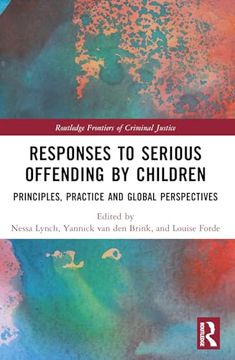
Responses to Serious Offending by Children (Routledge Frontiers of Criminal Justice) - Nessa Lynch (Editor) Yannick Nelson Van Den Brink (Editor) Louise Forde (Editor)
Cheaper New Book
Imported
to South Africa
Delivery: 27 Aug - 07 Sep
Shipping: 13 to 14 business days.
R 1,209
Faster New Book
Imported
to South Africa
Delivery: 14 Aug - 24 Aug
Shipping: 4 to 5 business days.
R 1,396
R 1,209
R 1,396
Choose the list to add your product or create one New List
Responses to Serious Offending by Children (Routledge Frontiers of Criminal Justice)
Nessa Lynch (Editor) Yannick Nelson Van Den Brink (Editor) Louise Forde (Editor)
Synopsis "Responses to Serious Offending by Children (Routledge Frontiers of Criminal Justice)"
This book explores the principles, practice and challenges in determining justice system responses to serious offending by children globally. Divided into four parts, the book provides a balance of theoretical and empirical insights. Anchored in a theoretical framework based on the human rights of children, as set out in the UN Convention on the Rights of the Child, it considers the relationship between scientific evidence (such as brain development) and the human rights framework, before going to explore the diversity of responses to children who are found responsible for serious offences. It brings together experts from various disciplines to fill a gap relating to serious offending by children in the literature. Scholars from Africa, Latin America and Asia, as well as Europe, North America and Oceania provide perspectives from legally, socially and culturally distinct jurisdictions. The first part focuses on the theoretical framework and explores the applicable standards and principles, including the relevant human rights framework and penological approaches to sentencing children for serious crimes. The second part analyses available empirical evidence, including evidence relating to the profiles of children who commit serious crimes, child and adolescent development, effective sentencing approaches and evidence of disparities in responses to serious offending by children. The third part provides a discussion of justice system responses to serious offending by children in a range of jurisdictions or regions with diverse and distinct legal, social and cultural contexts. Finally, the book uses the theoretical framework, empirical evidence, and case studies of jurisdictions to reflect on how principles relating to responses to serious offending by children can be translated into practice, and to highlight key debates and issues that will need to be explored into the future. Adding much-needed international perspectives to the scholarship addressing the issue, this book will be of great interest to academics, students, legal practitioners and social work professionals working on youth justice and children's rights across the globe.