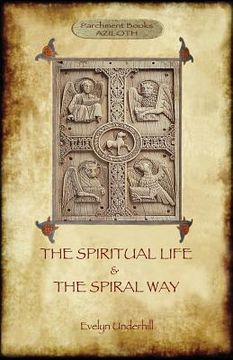
'The Spiritual Life' and 'The Spiral Way': two classic books by Evelyn Underhill in one volume (Aziloth Books)
Evelyn Underhill
Synopsis "'The Spiritual Life' and 'The Spiral Way': two classic books by Evelyn Underhill in one volume (Aziloth Books) "
Acknowledged as one of the most profound modern commentators on Christian mysticism, Evelyn Underhill did not easily find her own spiritual path. Between 1911 and 1921 she wrestled to understand spiritual experiences via academic research into early Christian mysticism and the life of individual mystics. This led her into active contemplation and, eventually, to the formation of her own profound view of the mystical path. The Spiritual Life derives from a series of four talks, broadcast on the BBC during the 1930s; its purpose is to circumvent technical theological terminology and to describe "some of the great truths concerning man's spiritual life in simple language". In this Underhill succeeds admirably, and the book has become a well-deserved classic. The Spiral Path is a longer study, describing the Christian path of fifteen mysteries that are to be followed in the soul's ascent to God. Both works are written in plain, easy-to-understand language - garnished with the wit and gentle wisdom that has made Evelyn Underhill a must-read for all who struggle to follow a spiritual life in the modern world.
Nació en Wolverhampton, Inglaterra, en 1875. Recibió una esmerada educación privada y asistió al King´s College para mujeres (Londres), donde estudió letras, historia, botánica y filosofía. Crecida en el agnosticismo, en 1907, durante una breve estancia en un convento franciscano, tiene lugar su conversión espiritual. A pesar de estar convencida de que la religión católica era la verdadera, diversas circunstancias impiden su adhesión a la Iglesia católica, y en 1921 optará finalmente por una pertenencia practicante al anglicanismo. En 1911, a raíz de la preparación y publicación de su obra fundamental La mística, conoce al barón Friedrich von Hügel, al que convertirá en su director espiritual; él influirá grandemente en su pensamiento y en su práctica religiosa. Repartió su actividad entre la escritura y la vida de devoción, asumiendo la dirección de retiros e impartiendo charlas y conferencias, dedicaciones que harán de ella unas de las maestras espirituales más importantes de su tiempo.
Autora de tres novelas y dos libros de poemas, destacan sus trabajos sobre mística y espiritualidad, que comprenden ediciones y comentarios de místicos y obras clásicas como Ruysbroeck, Walter Hilton, La Nube del no Saber o La Escala de Perfección. Entre sus numerosos libros cabe mencionar The Mystic Way: A Psychological Study in Christian Origins (1913), The Life of the Spirit and the Life of Today (1922), The Mystics of the Church (1925), Worship (1936), La práctica del misticismo (2015) y La mística (2ª edición en 2016), publicados en esta editorial.