Tracked shipping to South Africa with premium packaging for just R199 

Ship to
South Africa
0
  • argentina
  • chile
  • colombia
  • españa
  • méxico
  • perú
  • estados unidos
  • internacional

Select your country

Americas

Europe

Rest of the world

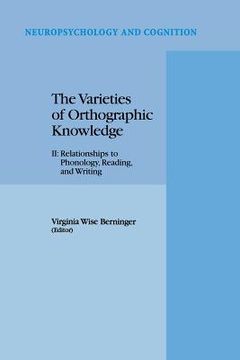
portada The Varieties of Orthographic Knowledge: II: Relationships to Phonology, Reading, and Writing
Type
Physical Book
Publisher
Language
English
Pages
421
Format
Paperback
Dimensions
23.4x15.6x2.3 cm
Weight
0.61 kg.
ISBN13
9789401041720

The Varieties of Orthographic Knowledge: II: Relationships to Phonology, Reading, and Writing

Berninger, V. W. (Author) · Springer · Paperback

The Varieties of Orthographic Knowledge: II: Relationships to Phonology, Reading, and Writing - Berninger, V. W.

Cheaper New Book Imported to South Africa
Delivery: 15 Oct - 28 Oct Shipping: 12 to 16 business days.
R 2,616
Faster New Book Imported to South Africa
Delivery: 06 Oct - 14 Oct Shipping: 5 to 6 business days.
R 3,446
R 2,616

Synopsis "The Varieties of Orthographic Knowledge: II: Relationships to Phonology, Reading, and Writing"

The role of orthography in reading and writing is not a new topic of inquiry. For example, in 1970 Venezky made a seminal contribution with The Structure of English Orthography in which he showed how both sequential redundancy (probable and permissible letter sequences) and rules of letter-sound correspondence contribute to orthographic structure. In 1972 Kavanagh and Mattingly edited Language by Eye and by Ear which contained important linguistic studies of the orthographic system. In 1980 Ehri introduced the concept of orthographic images, that is, the representation of written words in memory, and proposed that the image is created by an amalgamation of the word's orthographic and phonological In 1981 Taylor described the evolution of properties. orthographies in writing systems-from the earliest logographies for pictorial representation of ideas to syllabaries for phonetic representation of sounds to alphabets for phonemic representation of sounds. In 1985 Frith proposed a stage model for the role of orthographic knowledge in development of word recognition: Initially in the logographic stage a few words can be recognized on the basis of partial spelling information; in the alphabetic stage words are recognized on the basis of grapheme-phoneme correspondence; in the orthographic stage spelling units are recognized automatically without phonological mediation. In 1990 Adams applied connectionism to an analysis of the orthographic processing of skilled readers: letter patterns emerge from the association units linking individual letters.

Customers reviews

Frequently Asked Questions about the Book

All books in our catalog are Original.
The book is written in English.
The binding of this edition is Paperback.

Questions and Answers about the Book

Do you have a question about the book? Login to be able to add your own question.

Opinions about Bookdelivery

More customer reviews